Bringing Our Brightest Home: Kerala’s Plan to End the Brain Drain

Introduction: Retaining the Sovereign Brain Trust
The presentation of the revised 2026 state budget by Chief Minister and Finance Minister V.D. Satheesan exposed a harsh reality: Kerala's traditional economic model has run out of runway. Carrying a massive structural revenue deficit of over ₹35,355 crore, with 77.6% of state revenue consumed entirely by inherited committed liabilities (salaries, pensions, and debt servicing), the state can no longer rely on real estate speculation or unstable Gulf remittances to build public wealth. The fiscal status report makes one thing clear—trying to tax or borrow our way into prosperity is a structural impossibility. We must completely redesign our economic base.
For decades, Kerala’s greatest export hasn't been physical commodities; it has been human capital. The state funds world-class basic education and healthcare, only to watch its elite engineering talent, software architects, and researchers migrate to Bangalore, Chennai, Europe, and the UAE. This chronic brain drain is driven by a lack of advanced regional industrial containers capable of holding high-value global capital.
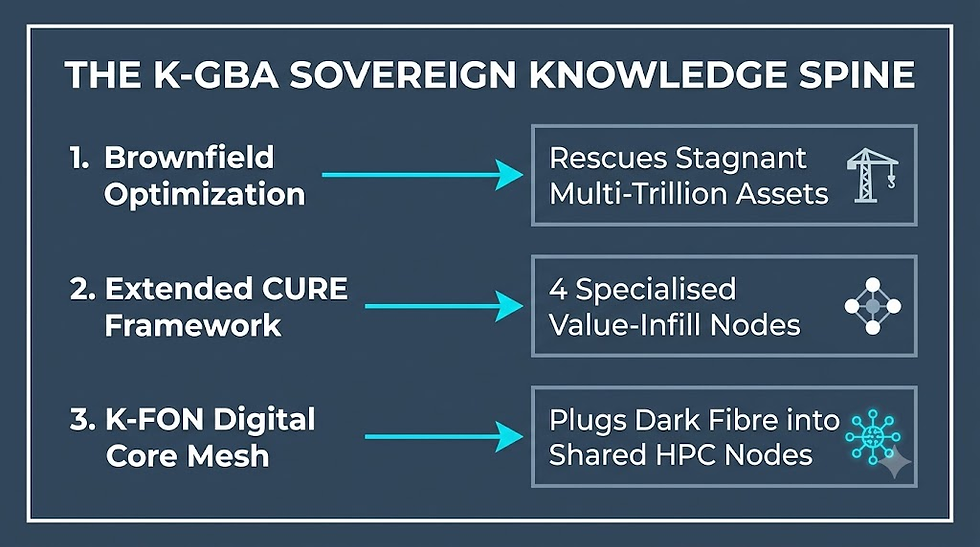
The conventional approach to solving this crisis is to propose massive, expensive new greenfield land acquisitions. The K-GBA playbook permanently discards this costly strategy. Instead of building from scratch, the Kerala Greater Bay Area (K-GBA) master plan focuses entirely on brownfield asset optimisation. By systematically rescuing thousands of acres of land already held in government escrow—currently sitting underutilised due to antiquated zoning limits—we eliminate the "where is the money" argument.
By applying radical FSI deregulation, establishing multi-state sunrise corridors, and tapping into advanced energy monopolies, Kerala will transform from an emigration economy into South Asia's premier deep-tech sandbox.
The Hardware-First Technical University & The Thorium Arbitrage
Traditional academic institutions inside Kerala are structurally broken by design. Managed by rigid, multi-layered bureaucratic boards, their text-heavy curricula take years to update, leaving graduates completely unequipped for the fast-evolving realities of frontier deep technology.
The K-GBA permanently bypasses this legacy system by chartering an elite, autonomous Hardware-First Technical University. Modelled directly on China's rapid deep-tech educational pivots and Israel’s specialised defence-linked laboratories, this institution utilises Section 3 of the UGC Act for Deemed-to-be-Universities to secure an immediate autonomous charter.
This legal architecture leaves it entirely independent of restrictive state university acts and legacy academic syndicates, operating as a rapid industrial production sandbox. The university mandates absolute focus streams in advanced robotics, quantum chip modelling, cryogenic software engineering, next-generation aerospace payload foundries, and industrial water desalination.

To ground this academic engine in a hyper-relatable physical container, the university will be housed directly within the underutilised acres of Technocity (Phase IV Pallipuram). Concurrently, the adjacent Bio 360 Life Sciences Park will be structurally rescued to host the Thorium & Advanced Energy Materials Consortium.
Kerala possesses a profound natural geopolitical asset: 13.15 million tonnes of coastal monazite placer sands containing the world’s most concentrated reserves of unmined thorium. For decades, this resource was treated as a dead asset, restricted by antiquated exploration frameworks.
Capitalising directly on the federal government’s newly launched Dedicated Rare Earth Corridors announced in the Union Budget 2026–27, Kerala will establish an off-balance-sheet research enclave inside the Bio 360 footprint. Operating under the structural umbrella of the EU-India Trade and Technology Council (TTC), this consortium partners directly with premier European advanced material laboratories. Rather than exporting raw sand and importing finished vulnerability, the enclave integrates advanced separation, metallization, and alloying natively within the state. This framework allows Kerala's indigenous deep-tech ecosystem to design and lock down the intellectual property (IP) for next-generation, thorium-based clean energy components, turning a raw mineral baseline into a high-yielding technology monopoly.

The Extended CURE Matrix & The Hill-to-Coast Balanced Living Sandbox
To prevent the catastrophic infrastructural collapses seen in peer tech regions like Bangalore—which expanded via unmanaged, flat horizontal greenfield sprawl—the K-GBA forces all industrial growth into compact, vertical, asset-light nodes. Adapting Hyderabad's highly successful division of its municipal architecture into specialised regional centres, Kerala introduces the Extended CURE Matrix. This framework divides the state's growth geography into four independent, non-competing municipal administrations connected via our 350+ km/h transit spine, eliminating single-city resource choke-points.
┌

I. The Cyber-Spine (Kochi-Thrissur): Unlocking GIFT & SmartCity
Focused entirely on high-density software engineering, post-quantum cryptographic design, and spatial compute clusters. Instead of initiating new land acquisition, this node structurally rescues the lagging GIFT City at Ayyampuzha and the vast vacant land banks of SmartCity Kochi (Phases 2 & 3).
By merging these assets into a single regulatory enclave, we establish a high-density vertical FinTech and Quantum Computing Cryogenic Sandbox. This vertical urban corridor features advanced cryogenic software testing sandboxes (extreme, super-cooled laboratory environments required to stabilise quantum processing operations). By providing startups with shared access to state-funded liquid helium cooling arrays and centralised multi-node High-Performance Computing (HPC) networks, the Cyber-Spine allows local enterprises to develop global AI models debt-free.
II. The Industrial Engine (Palakkad): Rescuing the KBIC Land Bank
Positioned as South Asia’s premier capital for fabless semiconductor design, Electronic Design Automation (EDA) tooling development (the highly specialised digital software blueprints needed to model and map out complex microchips), and electric vehicle (EV) component assemblies. This node overlays directly onto the Palakkad Industrial Smart City (Integrated Manufacturing Cluster - IMC), weaponising the 1,710 acres already accumulated under the Kochi-Bengaluru Industrial Corridor (KBIC).
Rather than chasing capital-heavy, environmentally draining physical silicon foundries, Palakkad capitalises on India Semiconductor Mission (ISM) 2.0. The enclave maps its technical curriculum directly to the ultra-precise software lithography platforms of global titans like ASML, training thousands of local engineers to design full-stack Indian semiconductor IP.
III. The R&D Capital (Thiruvananthapuram-Kollam)
Anchored entirely around our unparalleled defence and space infrastructure, infilling the Technocity and Bio 360 footprints. By leveraging the physical proximity of the Vikram Sarabhai Space Centre (VSSC) and native ISRO facilities, this node scales beyond ground logistics into low-Earth orbit economies. The cluster houses specialised micro-launch vehicle assembly foundries and advanced component manufacturing parks, short-circuiting the brain drain by allowing local talent to co-develop next-generation aerospace payloads directly with international space agencies.
IV. The Malabar Spoke (Kozhikode-Kannur): The Industrial Kitchen
The northern tier of the state is systematically activated by integrating the lagging phases of Cyberpark Kozhikode and surrounding KINFRA industrial parks into a high-yielding macro-logistics and agritech engineering corridor. Replicating the structural design templates of Japan’s regional agricultural-industrial clusters and China’s automated conversion frameworks, Malabar shifts completely away from raw, low-margin agricultural commodity trading.
Operating strictly as the "Industrial Kitchen" of the K-GBA, this spoke installs advanced automated sorting facilities, industrial flash-freezing plants, and state-of-the-art vacuum-sealing protocols natively within its logistics hubs. These systems are connected directly to automated, temperature-controlled cold-chain distribution corridors running parallel to our freight expressways. By preserving the absolute peak texture, flavour, and purity of regional agricultural assets without chemical additives, this infrastructure loops Malabar’s high-value agro-industrial outputs directly into outbound container lanes at Kochi and Vizhinjam, building a high-margin export engine.
The Human Synthesis: The Anti-Burnout Living Sandbox
This decentralised metropolitan configuration solves more than just physical traffic bottlenecks; it addresses the profound human isolation defining modern global technology hubs. The K-GBA does not build sterile, clinical corporate cities. By using our high-speed transit spine to link the mist-shrouded, high-altitude coffee estates of the Malabar hills directly to our coastal maritime nodes, the playbook introduces the world’s first Hill-to-Coast Lifestyle Balance.
A design director can raise a family in a serene, culturally rich, low-density rural community, commute to a hyper-dense vertical cleanroom in under 45 minutes, and return home to an environment untouched by urban degradation. High technology no longer requires sacrificing human well-being; the K-GBA turns geographical diversity into our primary talent retention tool. This physical base seamlessly integrates regional heritage with a highly anticipated 24/7 experiential culture that transforms how urban spaces live after dark.

Israel-Style Precision Aquaculture & Hydrological Grid Integration
Kerala’s 41 rivers and massive backwater networks are critical ecological assets that must be optimised rather than treated defensively. Traditional inland fishing across the state is economically vulnerable, under-scaled, and highly seasonal. To secure dominant alternative food supply lines and drive non-tax revenues, the K-GBA introduces Israel-Style Precision Aquaculture across our inland channels.
Partnering directly with leading Israeli agricultural-technology firms, the state will install sensor-driven Recirculating Aquaculture Systems (RAS) and automated vertical farming modules inside our non-fragile backwater edges. These systems use IoT water-quality monitors, automated algorithmic feeding nodes, and solar-powered microgrids to operate hyper-dense breeding bays at a fraction of standard cost footprints.
By utilising our continuous inland channel profiles for high-margin marine husbandry alongside our automated cargo barges, the state generates a highly reliable food production network. This initiative insulates the local market from climate-induced marine supply shocks, compresses regional food logistics costs by 40%, and opens up a lucrative new blue-economy export vector straight to our international shipping lanes.

Fast-Track Private Tech Park Concessions & The K-FON Data Backbone
Global Collaboration Centres (GCCs) and Fortune 500 engineering headquarters require immediate operational readiness, unassailable legal certainty, and zero bureaucratic friction. To court these anchors into our vertical corridors, the K-GBA framework establishes an aggressive Zero-Red-Tape Regulatory Fast-Track for private tech park operators.
┌

Under this statutory concession framework, any private developer constructing high-density, vertical tech parks (utilising an FSI of 10.0x) is entirely exempted from multi-layered department clearance cycles. Approvals are granted programmatically within 14 days via our singular K-GBA Spatial Dashboard, provided the design complies with pre-certified green building codes and closed-loop utility metrics.
To make these spaces irresistible to global design consortia, the state weaponises K-FON (Kerala Fibre Optic Network). Instead of leaving K-FON underutilised as a passive network asset, we plug its massive dark-fibre mesh directly into the cores of our vertical tech parks. This core infrastructure anchors our centralised, public-subsidised High-Performance Computing (HPC) Arrays.
Startups and global corporate teams leasing space in these vertical enclaves receive plug-and-play access to unmatched raw computing power without incurring individual capital expenditures. By shifting the state’s industrial incentives from raw tax holidays to world-class computing infrastructure concessions, Kerala can systematically attract top-tier global engineering clusters debt-free.
The Pluralistic Dividend: Secular Stability as Structural Insurance
When a global enterprise deploys long-term institutional capital, its primary unmapped risk is social and political volatility. Kerala’s greatest unfair economic advantage is its centuries-old, organic fabric of multi-cultural and multi-religious pluralism. This generational record of deep communal harmony is not merely a proud social triumph; it functions as a powerful de-risking asset for global investors.
Furthermore, by leveraging the state’s unmatched gender equity indicators—rooted in a historic matriarchal heritage and backed by the highest female literacy rates in South Asia—multinational engineering headquarters can naturally build inclusive, balanced workforces that are highly resilient. In the K-GBA, social equity and structural market stability are hardcoded into the exact same terrain.
High-Margin Premium Upskilling & Experiential Tourism
Traditional hospitality and localised tourism models generate remarkably low margins, shackling our scenic hill stations and coastal corridors to low-wage, highly seasonal service roles. To capture premium international capital, the state must transform its workforce training pipelines, adapting the elite upskilling frameworks engineered across Taiwan, Thailand, and Vietnam.
The K-GBA replaces generic vocational hospitality training with specialised, international-standard certification academies:
International Maritime Yacht Husbandry: Training local youth in the high-precision engineering, maintenance, and navigation systems required to service global luxury vessels calling at our deepwater ports and cruise terminals.
Advanced Eco-Resort Smart Architecture: Equipping local professionals with the technical skills to design and manage automated, zero-carbon, closed-loop hospitality structures integrated into sensitive environments.
Premium Destination Wellness Operations: Professionalising our traditional Ayurvedic and wellness assets into high-margin medical-tourism ecosystems that command premium global valuations.
By positioning these highly specialised professionals along the continuous inland cruise networks and upgraded Sagarika Home Port enclaves built via Mission Samudra, Kerala transforms its tourism sector from a localised service into a premium global asset.
Strategic Project Implementation Tracker (Next 60 Months)
┌──────────────────────────────────────────────

Phase | Timeline | Primary Operational Deliverable | Lead Executing Authority |
Phase I | Months 0 - 12 | Launch the open-source Digital Commons Architecture layer, providing remote access to licensed EDA software simulation tools across K-FON endpoints. | Department of Higher Education / K-GBA IT Cell |
Phase II | Months 12 - 24 | Establish the Thorium Consortium Enclave inside the rescued Bio 360 Life Sciences Park under the EU-India TTC framework. | Department of Industries / Ministry of Critical Minerals |
Phase III | Months 24 - 36 | Re-zone and execute high-FSI parameters at the Ayyampuzha GIFT City site and the Palakkad IMC land bank. | Department of Urban Affairs / KBIC SPV Board |
Phase IV | Months 36 - 60 | Deploy shared public HPC Arrays inside Technocity Phase IV and SmartCity Kochi building cores. | Kerala State IT Mission / PPP Command Board |
Activating South Asia's Brain Engine
The financial diagnostics are completed, the structural leaks are plugged, and the spatial rules have been entirely rewritten. Kerala cannot secure its economic future by remaining a passive consumer enclave or relying indefinitely on the export of its raw talent.
By rescuing our underutilised multi-trillion-rupee land banks, dividing our geography into the highly specialised Extended CURE Matrix, and weaponising our natural monazite, K-FON, and multi-cultural assets, we unlock an unassailable regional monopoly. The infrastructure blueprints are completed, the off-balance-sheet financing mechanisms are active, and the sovereign enclaves are ready. It is time to execute the master plan, retain our human capital, and construct the high-tech future of Kerala.
A Question for the Community
By establishing the Extended CURE Matrix—balancing Palakkad's fabless chip design core with the Cyber-Spine's quantum computing enclaves—we follow the elite planning frameworks of Tokyo Bay and Singapore.
To optimise our initial 5-year deployment cycle, should our state prioritise immediate deployment of the open-source Digital Commons software layer across K-FON, or focus entirely on building out the physical Thorium Consortium laboratories at Bio 360? Share your analytical perspectives and structural ideas in the comments below.


Comments