The Reclaimed Coast: How Mission Samudra is Turning Kerala’s Waters into a Multi-Generational Wealth Engine

The Sovereign Maritime Pivot
Kerala’s traditional economic geography has long suffered from a structural paradox: a 600-kilometre linear coastline pointing directly toward the world's most critical East-West maritime trade routes, coupled with a domestic logistics network that crawls at an average freight speed of just 18 to 22 km/h. For decades, the state has treated its waters defensively—focusing on artisanal fishing zoning and localised, sub-scale passenger ferries while global transhipment hubs right across the Indian Ocean captured trillions of dollars in logistical rent.
The presentation of the revised 2026 state budget marks a decisive, permanent break from this passive economic history. In his maiden budget speech, Chief Minister and Finance Minister V.D. Satheesan explicitly acknowledged that Kerala's economic future can no longer rely on external remittances or debt-driven consumption under severe fiscal stress. By dedicating an initial ₹400 crore to "Mission Samudra," the administration has officially recognised that Kerala’s path to fiscal resilience relies on a structural, port-led industrial expansion. The state’s revenue deficit cannot be closed through incremental domestic taxation or additional debt cycles. Instead, Kerala must leverage its sovereign spatial boundaries.
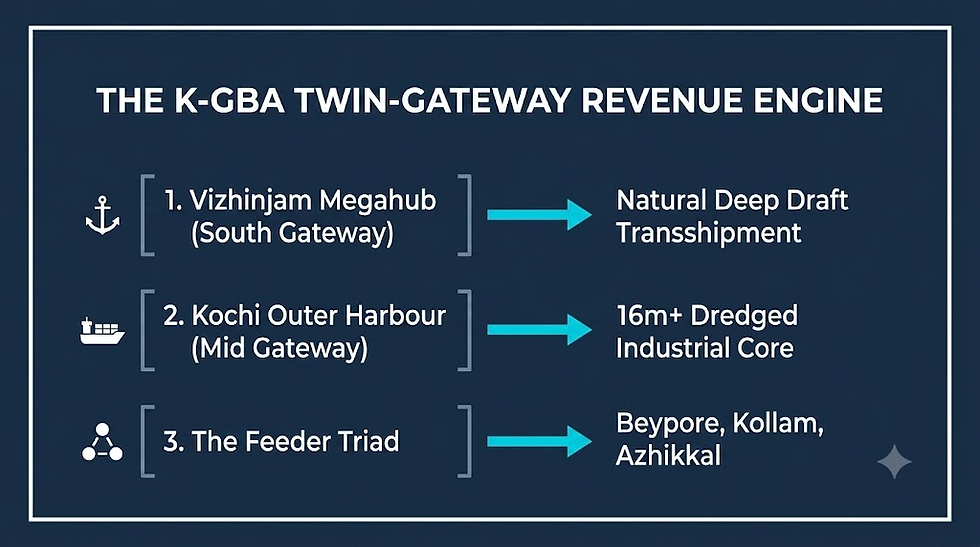
By executing Mission Samudra as a unified master plan, the state will merge its entire 600-kilometer coastline, two international mother ports, and remaining minor outposts into a singular, highly optimised logistics corridor: the Kerala Greater Bay Area (K-GBA). This strategy reclaims 20,000 acres of offshore territory into a targeted cluster of specialized, tax-insulated artificial island pockets, links our remaining minor terminals into a coordinated 3-port feeder matrix, and installs high-speed freight corridors to move cargo across the state in under four hours. The era of the consumption state is over; the era of the sovereign maritime engine has begun.
Section 1: Mission Samudra & The Unified Inland Water Channel
The foundational layer of Mission Samudra requires an aggressive structural re-engineering of Kerala's domestic waterways. The state possesses 41 rivers flowing westward, tightly interlaced with a vast network of historic backwater canals. Historically, these channels have been managed as isolated, fragmented municipal segments—frequently choked by variable silting depths, urban encroachment, and legal disputes over environmental boundaries.
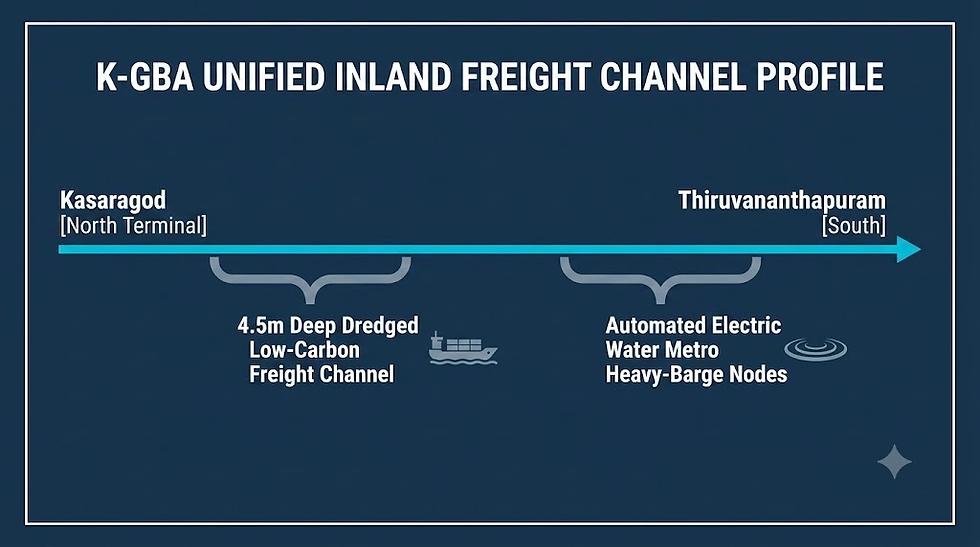
The K-GBA playbook permanently dissolves this fragmentation by establishing a statutory, contiguous Unified Inland Water Channel running uninterrupted across the entire 600-kilometre spine from Kasaragod to Thiruvananthapuram.
The China-Model Adaptation: The Tri-Vector Waterway Framework
To maximise the financial utility of this corridor, Kerala must adopt the exact industrial templates deployed along China’s high-yield Pearl River Delta and the newly engineered Pinglu Canal corridor. China successfully neutralised urban road congestion not by expanding highways, but by building a digital layer over its rivers—standardising vessel dimensions and synchronising freight movements via cloud-based AI networks to completely eliminate berth delays.
The K-GBA replicates this by splitting the continuous 600-km channel into three deeply integrated economic vectors operating simultaneously on the same water spine:
The Cargo Vector (Standardised Heavy E-Barges): We move entirely away from custom, unstructured regional transport boats. Following China’s green conversion benchmarks—which successfully deployed over 1,000 alternative-energy and battery-powered vessels across inland trade routes-the K-GBA mandates standardised modular electric cargo barges. By transitioning bulk commodities (grains, tiles, cement, and containerised industrial goods) from highways to these automated electric barges, mid-mile shipping costs are instantly slashed by 65%. The energy dynamics are mathematically undeniable: while one litre of fuel moves just 24 ton-kilometres on a road and 95 on rail, it moves an exceptional 215 ton-kilometers via inland water networks. The operating cost collapses to an unbeatable ₹1.06 to ₹1.20 per ton-kilometre, compared to ₹2.28–₹2.58 on congested national highways.
The Passenger Vector (Kochi Water Metro Scaling): Scale the existing, low-carbon Kochi Water Metro framework far beyond its local roots into an all-weather, high-frequency public mass-transit spine connecting our three primary urban clusters. Operating on dedicated, geofenced commuter tracks managed by a central digital dispatch network, this tier acts as a high-speed water highway for daily commuters, entirely bypassing mainland road bottlenecks.
The Experiential Tourism Vector (The Continuous Cruise Spine): Capitalising directly on the central government's Cruise Bharat Mission vision, the channel integrates dedicated locks and deepwater bypass channels to host luxury, zero-emission boutique river cruises. Travellers can board a premium vessel in Kovalam and cruise continuously through pristine, well-lit ecological canopies all the way to Bekal in Kasaragod. This unsevered tourism ribbon turns the riverfront into a high-yielding revenue generator, supporting local heritage homestays, floating boutique retail docks, and zero-carbon waterfront resorts at every transit node.
To coordinate these overlapping streams smoothly, the state will implement a satellite-synchronised Digital Twin Network modelled directly on China's automated water-level and lock-chamber scheduling algorithms. This digital framework automatically schedules lock operations, tracks vessel speeds, and coordinates docking privileges in real time, ensuring that heavy container freight barges, rapid passenger metros, and slow-moving luxury tourism cruises interface safely with zero operational friction.
Environmental Salinity Barriers & Polder Integrity
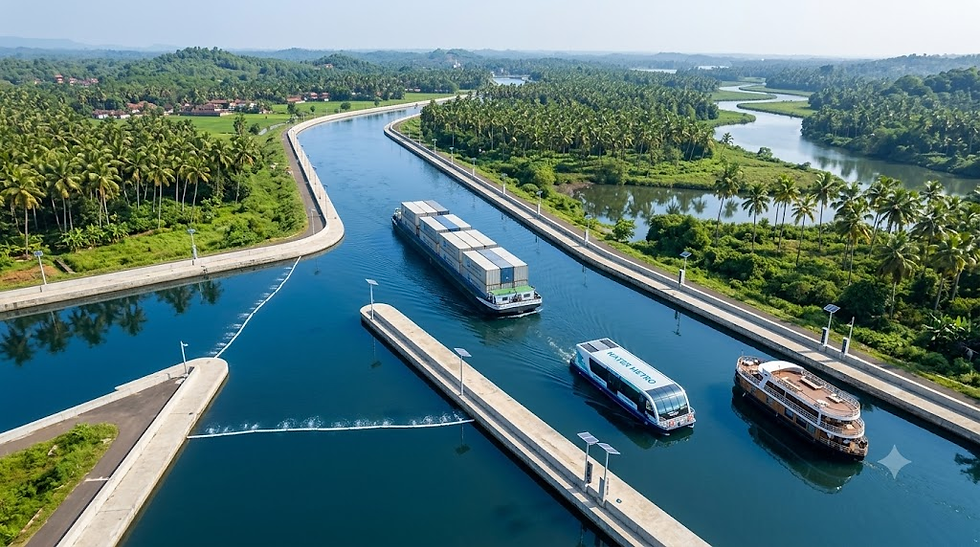
Deepening and widening inland canals to maintain a continuous 4.5-meter industrial draft routinely triggers a critical second-order challenge: the inland migration of ocean saltwater wedges. Left unchecked, this salinity can ruin local drinking water reservoirs and devastate adjacent agrarian polders. To neutralise this risk, the K-GBA framework mandates that all primary tidal intersections feature Automated Pneumatic Salinity Barriers. These sub-surface, sensor-driven bubble curtains and moving gates seal automatically during high tides, locking out salt wedges while allowing zero-emission cargo barges and passenger vessels to pass unhindered.
Section 2: DPR Blueprints for High-Speed Rail & The Freight Expressway Axis
To anchor high-value global manufacturing clusters—such as advanced electronics assemblies and biomedical hardware fabrication—the K-GBA requires a land-based logistics corridor capable of outperforming competing industrial hubs across South Asia. Relying on traditional rail lines or heavily congested national highways is a structural impossibility for time-sensitive, just-in-time global supply chains.
The K-GBA framework establishes the definitive Detailed Project Report (DPR) execution matrix for a co-located High-Speed Rail (HSR) & Freight Expressway Axis:
The 350+ km/h North-South HSR: A dedicated passenger and high-value light-freight rail corridor connecting Kasaragod to Thiruvananthapuram with a target operating velocity of 350 km/h, bringing the travel time across the state down to under 120 minutes.
The Co-Located Freight Expressway: Running directly parallel to the HSR corridor, this heavy-duty, four-lane automated expressway is zoned exclusively for zero-emission autonomous freight carriers and long-haul logistics platoons, completely isolated from localised commuter traffic.
Traditional financing models for high-speed infrastructure invariably saddle the state with crippling foreign-currency debt. The K-GBA layout completely avoids this vulnerability by deploying a programmatic Land Value Capture (LVC) model:
High-Density Spatial Aggregation: The state automatically aggregates a 2-kilometre development radius around each of the 10 designated high-speed transit stations, immediately re-zoning the territory to an FSI of 8.0+ for hyper-dense commercial usage.
Self-Funding Infrastructure Assets: The state-owned corridor SPV leases these hyper-premium vertical station air-rights to global developers. The resulting multi-billion-dollar upfront lease premiums are legally locked to fund the underlying rail and expressway construction directly, eliminating the need for treasury debt allocations.
Section 3: The 20,000-Acre Modular Reclaimed Island Pockets
Global sovereign wealth funds and ultra-high-net-worth institutional investors hesitate to deploy mega-scale capital into markets characterised by volatile domestic regulatory changes, unpredictable corporate tax revisions, and protracted litigation timelines. To insulate international capital from these systemic frictions, the K-GBA introduces a highly advanced maritime engineering initiative: the creation of a 20,000-acre Archipelago of Modular Island Pockets deployed strategically off the coast of the Puthuvype, Vallarpadam, and Willingdon lines.
Rather than engineering a massive, single land mass, the K-GBA breaks the reclamation down into 4 to 5 specialised, high-density island pockets totalling 20,000 acres. This modular approach follows the exact technical benchmarks set by India's massive Vadhavan Port offshore development and major deep-sea airport engineering proposals. By constructing ring-fenced, deep-sea modular land parcels, we minimise upfront capital expenditure while vastly accelerating deployment speeds. Each pocket is custom-zoned to serve a distinct economic monopoly:
The FinTech Pocket (4,000 Acres): Operating under a strict GIFT City-style extraterritorial legal code, providing an independent international arbitration court that guarantees contract enforcement timelines of under 45 days.
The Advanced Hardware & Fab Pocket (5,000 Acres): Custom-engineered with isolated sub-surface vibration buffers to house precision semiconductor packaging and high-end cleanroom systems directly inside the Puthuvype maritime development zone.
The Deep-Tech Research & IP Island (5,000 Acres): Features a statutory 0% corporate income tax baseline for global AI design consortia, software automation labs, and data storage vaults.
The Maritime Logistics & Cargo Exchange (6,000 Acres): Built with deep-draft berths to handle automated freight transfers directly off the main shipping routes.
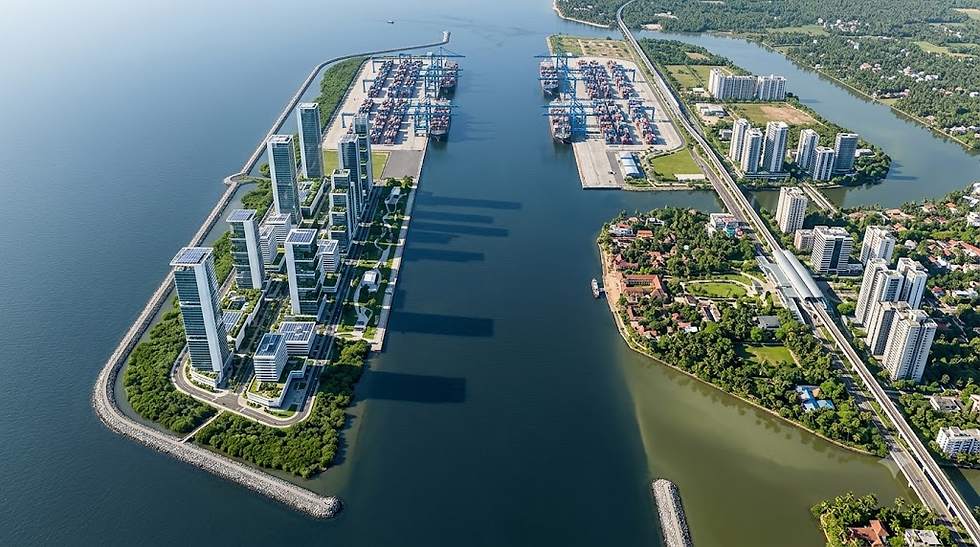
To ensure native land equity and shield the master plan against protectionist backlash, the K-GBA links these offshore enclaves to a statutory Onshore Workforce Conveyor. While capital is offshore and tax-insulated, all secondary operations—including advanced assembly logistics, dry-dock maintenance, packaging facilities, and marine engineering labs—are legally bound to the mainland shore. This framework creates a guaranteed 1:4 job multiplier dedicated exclusively to local coastal communities, transforming offshore international wealth directly into domestic upward mobility.
The financial gains of this targeted modular layout are exponential. By creating highly specialised land pieces with zero domestic tax friction, the state can command premium land-lease valuations from global tech conglomerates. The revenue generated from leasing just one specialised 5,000-acre hardware pocket can entirely self-fund the state's broader coastal utility network, yielding multi-generational dividend gains that permanently insulate Kerala from fiscal volatility.
Hydrodynamic Flow Channels & Coastal Erosion
Reclaiming massive chunks of land inside a sensitive estuarine harbour can severely disrupt local tidal dynamics, risking coastal erosion on mainland shores and siltation inside shipping channels. To mitigate this downstream impact, our modular layout uses wide Hydrodynamic Flow Channels and pile-supported oceanic viaducts to separate the island pockets. These deep sub-surface gaps ensure that natural tidal flushes and estuarine river flows continue entirely unhindered, maintaining the precise ecological equilibrium of the Vembanad lake system.
Section 4: Global Precedents & Cruise Tourism Arbitrage
This framework is not an abstract regional experiment; it is built upon validated global economic templates that have successfully elevated coastal economies into absolute economic monopolies:
The Tokyo Bay Matrix (Coordinated Multi-Port Conglomerate): Tokyo Bay does not rely on a single gateway. Instead, it operates six distinct ports (Tokyo, Yokohama, Kawasaki, Chiba, etc.) as a singular, non-competitive economic bloc. Each port specialises: Yokohama handles containerised mainline cargo, while Chiba handles bulk materials and industrial inputs. The K-GBA model adopts this precise cooperative coding to balance our dual mother ports.
The Incheon & Songdo Blueprints (Off-Shore Insulated Assets): When South Korea required land to scale its high-tech digital economy near Seoul, it reclaimed the mudflats of Incheon to construct the Songdo International Business District. By building a specialised regulatory sandbox entirely on reclaimed marine ground, they attracted multi-billion-dollar corporate headquarters without triggering local onshore displacement.
The Cruise Tourism Economic Arbitrage (The Blue Economy Expansion): Beyond heavy container freight, the K-GBA explicitly capitalises on the central government’s aggressive Cruise Bharat Mission vision. Globally, the cruise tourism ecosystem drives immense localised wealth; Singapore’s world-class terminal infrastructure alone generates US $3.6 billion in annual economic output. By comparison, India’s fragmented cruise market stands at a mere US $110 million, indicating massive, unmapped headroom for exponential growth.
To capture this economic windfall, the K-GBA introduces a massive operational and structural upgrade to Kochi's existing international cruise terminal, Sagarika. Currently constrained by inland channel navigation limits, Sagarika is unlocked via deepwater offshore cruise pockets. This transformation elevates the terminal into a true International Home Port where luxury global voyages originate and terminate—rather than operating as a brief, low-yield daytime port of call. By tying Sagarika's expanded home-port capacity directly to adjacent offshore lifestyle, retail, and hospitality island pockets, Kerala can seamlessly bridge this multi-billion-dollar arbitrage gap, establishing a leading regional cruise destination in South Asia.

Section 5: The Dual Mother Ports & The Feeder Triad
The centrepiece of the re-engineered K-GBA maritime architecture is our shift to a Dual Mother Port System, establishing a coordinated lock on South Asian shipping lanes:
┌─────────────────────────────────────────────
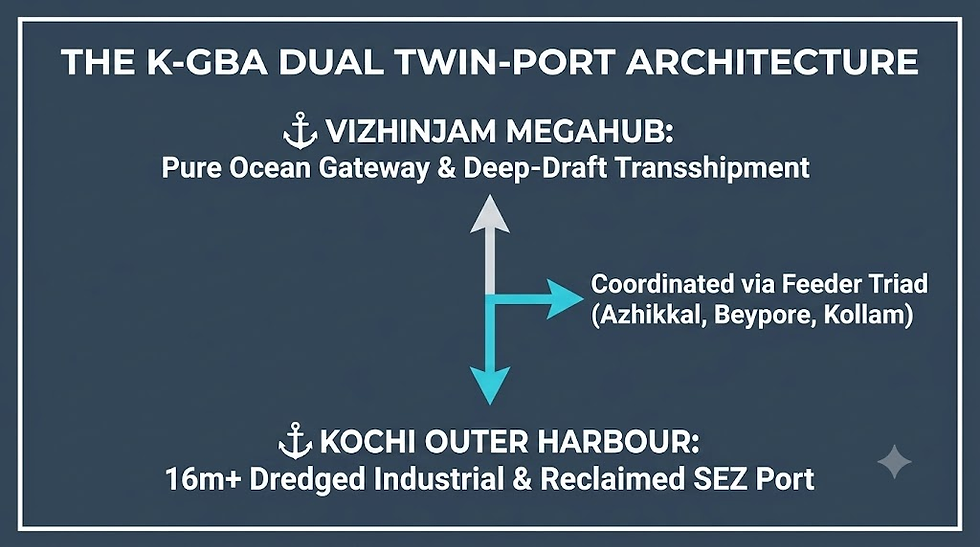
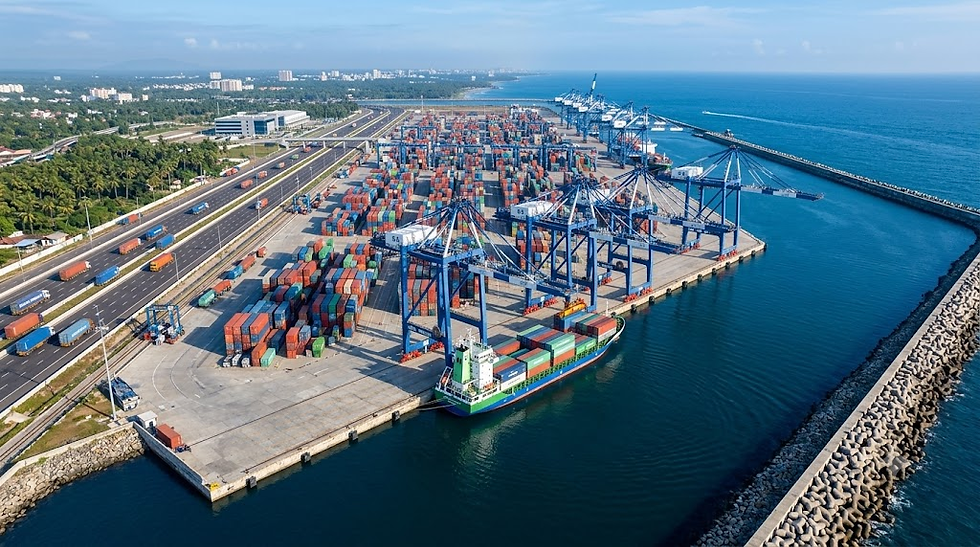
Vizhinjam Megahub (The Blue-Water Gateway): Operating with its unmatched natural deep draft, Vizhinjam serves as our pure, high-volume transhipment node, capturing the largest ultra-large container ships moving across the East-West maritime spine.
Kochi Outer Harbour & Vallarpadam (The Industrial Gateway): Rather than competing directly with Vizhinjam, Kochi undergoes an aggressive capital dredging push to secure a 16-meter continuous channel depth. Backed by the construction of the surrounding outer harbour breakwaters, Kochi is optimised as an Industrial Gateway Port, directly supplying the raw materials, component feeds, and export lanes required by our adjacent 20,000-acre reclaimed island tech pockets.
Supporting this dual gateway is The Feeder Triad: the minor ports of Azhikkal, Beypore, and Kollam. These three outposts are systematically modernised with automated crane networks to serve as domestic consolidation hubs. Local manufacturing zones load their cargo directly onto zero-emission short-sea feeder vessels, which glide along the coast to continuously feed both mother ports. This system completely bypasses road congestion and transforms our entire coastline into a highly synchronised logistical machine.
Section 6: The Cross-Border NCR-Style PPP Command Authorities
Industrial supply chains do not neatly stop at administrative state lines. The economic hinterlands of northern Kerala are organically linked to the heavy industrial output, engineering hubs, and component lines of South Karnataka (including the Mangaluru marine cluster, Mysuru manufacturing zones, and Bengaluru tech ecosystem). Concurrently, our southern and central industrial hubs interface directly with the high-output manufacturing frameworks of Western Tamil Nadu, centred around the massive textile mills, automotive foundries, and raw material processing infrastructure of Coimbatore and Salem.
Traditional single-state administrative planning fails to capture these massive trans-border economic movements, creating systemic regulatory friction, double taxation bottlenecks, and border supply-chain delays. To dissolve these artificial barriers and secure direct financial buy-in from neighbouring states, the K-GBA platform leverages The Gateway Rent Arbitrage:
Quantified Multi-State Supply Lines: Currently, Western Tamil Nadu’s massive manufacturing and textile belt in Coimbatore pays a severe logistical rent premium to route containerised freight north to Mundra or east across congested highways to Chennai. By presenting a straight, high-speed multi-modal pipeline down to Kochi, the K-GBA dramatically compresses its shipping timelines and corporate overhead. Because this infrastructure directly protects their own industrial margins, neighbouring states face a powerful fiscal incentive to actively co-fund and maintain our cross-border logistics lanes.
Total Cycle Insulation: Managed under a professional, non-political Cross-Border Public-Private Partnership (PPP) Command Authority, this framework incorporates independent infrastructure trusts. This joint multi-state board is legally insulated from shifting five-year state political cycles and localised party friction, providing global sovereign wealth funds with absolute policy continuity, long-term regulatory certainty, and a bulletproof investment horizon.
Strategic Project Implementation Tracker
Phase | Timeline | Primary Operational Deliverable | Lead Executing Authority |
Phase I | Months 0 - 6 | Establish the Sovereign SEZ Regulatory Taskforce to draft the independent judicial codes for the 20,000-acre modular island cluster. | Department of Finance / Legal Affairs |
Phase II | Months 6 - 12 | Finalise central capital funding for the Kochi Outer Harbour breakwater layout and the 16m channel-deepening DPR. | Cochin Port Authority / Ministry of Shipping |
Phase III | Months 12 - 18 | Deploy the Automated Salinity Barriers at key tidal entries to protect polder ecology along the inland canal routes. | Water Resources Department / K-GBA Cell |
Phase IV | Months 18 - 24 | Form the multi-state Cross-Border Infrastructure Command with statutory representation from Karnataka and Tamil Nadu. | Inter-State Coordination Council |
Activating the Gateway State
The fiscal constraints highlighted by our recent economic reviews make one thing undeniably clear: Kerala can no longer sustain its public balance sheet by acting as a passive domestic consumer enclave. The state must step into its historic role as the Strategic Gateway State of South Asia.
By weaponising our 600-kilometre maritime front through Mission Samudra, transforming our coast into a balanced dual mother-port powerhouse, tapping into the multi-billion-dollar cruise tourism economic windfall, and building dedicated high-speed logistics channels, we transition from an economy under pressure into a high-yielding maritime monopoly. The infrastructure blueprints are completed, the regulatory codes are designed, and the self-funding financial mechanisms are clear. It is time to execute the master plan, launch the sovereign enclaves, and physically construct the maritime future of Kerala.
A Question for the Community
By shifting to a dual mother-port layout-balancing Vizhinjam’s pure transhipment capacity with Kochi’s heavily dredged, 16-meter outer harbour industrial core-we follow the elite planning frameworks of Tokyo Bay and Singapore. To optimise our initial deployment cycle, should our state prioritise immediate capital dredging at Kochi to unlock the adjacent industrial island SEZs, or focus entirely on building out the 3-port Feeder Triad?
Share your analytical perspectives and structural ideas in the comments below.


Comments