The Geopolitical Trinity: How Kerala Can Fusion-Replicate Taiwan, Singapore, and the Netherlands

For decades, Kerala’s developmental discourse has been trapped in a circle of defensive planning. We are consistently told that our unique constraints—acute land scarcity, high population density, and intense tropical monsoons—are permanent roadblocks to becoming a global economic powerhouse.
This is a profound failure of imagination.
When you strip away the map lines, Kerala possesses almost the exact same geographic, climatic, and human capital footprints as three of the most prosperous economies on Earth: Taiwan, Singapore, and the Netherlands. These nations didn’t succeed despite their constraints; they engineered those exact constraints into global monopolies.

With a decisive political mandate now taking charge under Chief Minister V.D. Satheesan, the time for patchwork infrastructure is officially over. We don't need to reinvent the wheel. We need a structural fusion of three proven global models to unlock a $4 trillion nominal GDP economy.
1. The Taiwan Mirror: Activating the High-HDI Tech Foundry
To understand Kerala's true potential, look at the macroeconomic data.
Metric | Kerala | Taiwan |
Land Mass | ~38,863 sq. km | ~36,197 sq. km |
Population | ~35 Million | ~23.5 Million |
Human Capital Profile | Hyper-literate, High HDI | Hyper-literate, High HDI |
In the 1970s, Taiwan was a light-manufacturing island. It didn't achieve global dominance by building scattered, generic industrial parks. Instead, the Taiwanese government launched aggressive, highly concentrated state-backed technology initiatives, established the Hsinchu Science Park, and focused obsessively on a single high-value niche: hardware and semiconductors.

Kerala has spent decades exporting its hyper-educated talent pool to build the economies of Bengaluru, the Middle East, and Europe. To halt this structural leakage, we must look at the hard fiscal numbers:
The Brain Drain Deficit
Every batch of 100,000 migrating knowledge workers (software engineers, advanced tech professionals, and creators) who leave the state represents an estimated ₹12,000 crore annual drain in direct consumption, state-level SGST, and high-bracket income velocity. Kerala effectively subsidizes world-class foundational education, only for competing economies to reap the fiscal rewards.
By shifting to a consolidated 3-Megapolis Strategy, we can permanently plug this leak. We don’t need to build everything. By clustering our software expertise in the Malabar Megapolis and connecting it to hardware design and precision assembly hubs along our core corridors, Kerala can transform into the next premier tech foundry.
However, this requires a fundamental shift in capital allocation:
The R&D Spend-to-GDP Benchmark
Taiwan's Strategy: Allocates nearly 3.5% to 4% of its entire GDP purely into dedicated deep-tech Research & Development.
The Indian Average: Hovers below 0.7%, with state funding traditionally scattered across generic, low-yield university grants.
The Kerala Leap: We must establish the Kerala Advanced Research Projects Agency (K-ARPA). Funded directly via structural equity tranches, K-ARPA will bypass broad incubators to heavily fund hyper-focused, state-of-the-art semiconductor architecture and automated system design houses.
2. The Singapore Blueprint: Reclaiming the Ocean Corridor
A common pushback to the vision of a high-density, centralised metropolis in Kerala is land availability. Sceptics claim we are too physically constrained to build a global mega-city.
Lee Kuan Yew faced the same critique. Singapore had zero natural resources and acute land scarcity. It didn't let its borders dictate its destiny; it grew outward, reclaiming over 25% of its entire land mass directly from the ocean. We don't need to look to Southeast Asia for proof that this works—we just need to look at our own history. In the 1930s, using rudimentary dredging technology, we engineered Willingdon Island out of Kochi’s backwaters.

It’s time to scale that historical blueprint. By executing a 50,000-acre reclaimed island city near Vallarpadam and Vypeen, we can bypass inland land constraints entirely. When contrasted with traditional inland development, the math overwhelmingly favours marine engineering:
Comparative Unit Economics: Mainland vs. Reclaimed Ocean
Parameter | Mainland Urban Acquisition | Deep-Sea Island Reclamation |
Legal/Social Friction | High resistance, multi-year litigation, fragmented family-plot holdouts. | Zero local displacement, zero rehabilitation overheads, swift state domain. |
Execution Velocity | 7–10 years average from notification to possession. | 24–36 months for engineering and complete site readiness via modern dredging. |
Capital Efficiency | Compounding acquisition costs due to speculative real estate inflation. | Predictable, fixed capital expenditure per square meter of dredged volume. |
(Note: Unit economics are conservative baseline models derived from global maritime engineering averages and historical state asset valuations.)
To protect the international capital flowing into this engineered landmass, we must implement a radical regulatory shield while answering the inevitable "democracy trap" objections:
Statutory Architecture of the Autonomous SMZ
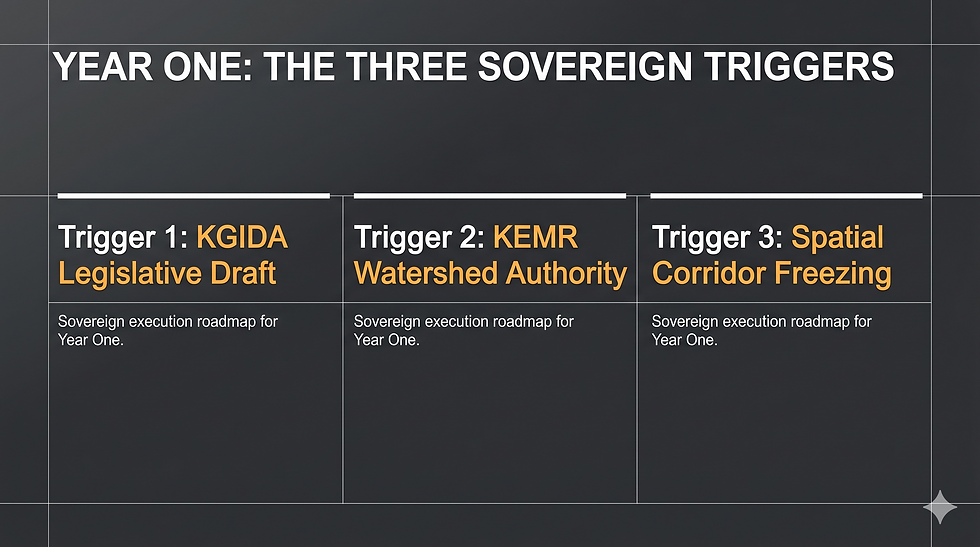
The proposed island city must operate under a legislative framework called the Kerala Global Investment and Development Act (KGIDA). This creates an independent, autonomous Special Management Zone (SMZ) modelled directly on the Dubai International Financial Centre (DIFC) and early Shenzhen.
Legal Independence: The SMZ will operate on an independent common-law judicial framework distinct from the mainland to resolve commercial and civil disputes seamlessly.
Fast-Track Sandbox: Global tech and maritime conglomerates will operate under a 99-year lease structure directly backed by sovereign guarantees, featuring single-window fast-tracked patent filings and autonomous local compliance.
The Local Dividend: Far from being a "corporate enclave," the SMZ acts as a hyper-efficient wealth generator designed to insulate the mainland from commercial volatility. The immense tax revenues and surpluses generated here will directly bankroll and sustain the education, health, and social welfare safety nets of mainland Kerala's municipalities.
3. The Netherlands Shield: Turning Climate Risk into Engineered Asset
The most vocal anxiety surrounding Kerala's development—voiced by local citizens and global investors alike—is our vulnerability to intense monsoons and recurring floods. If a busy commercial hub like the Edappally toll area floods every rainy season, how can we dream of building a global metropolis?
The answer lies in the Netherlands. Over 25% of the Netherlands sits entirely below sea level. It is a low-lying delta facing brutal North Sea storms and massive river systems. Yet, institutional funds view Dutch real estate as one of the safest, most stable assets on the planet. Why? Because the Dutch stopped fighting water with patchwork dykes and deployed the "Room for the River" strategy, building automated storm-surge barriers, dedicated polders, and hyper-engineered drainage networks.

Our urban flooding is not an "Act of God"—it is a symptom of fragmented municipal planning. We must contrast the massive financial toll of our current approach with the stability of engineered resilience:
The Fiscal Ledger: Cost of Inaction vs. Cost of Resilience
The Cost of Inaction (The Status Quo Tax): The 2018 floods alone cost Kerala an estimated $4.4+ billion (₹31,000+ crores) in direct damages, destroyed infrastructure, and lost economic productivity. Patchwork repairs eat away at the state treasury every monsoon cycle without fixing the underlying structural flaws.
The Cost of Resilience (The Dutch Solution): Investing in unified regional storm barriers, automated polder pumping systems, and deep drainage arteries requires an upfront capital layout. Over a 20-year horizon, however, this expenditure transitions from an ongoing liability into a high-yield insurance policy that permanently de-risks multi-billion-dollar global assets.
Fixing the persistent inundation of economic hubs like Edappally or Ernakulam cannot be achieved through localised municipality drainage contracts. It requires a fundamental shift from civil contracting to deep climate engineering.

By replacing the outdated, micro-managed local boundaries of the 1960s with unified regional watershed authorities like the Kochi Extended Metro Region (KEMR), we can deploy a comprehensive water management master plan. By integrating our 44 rivers and vast backwater networks into a single engineered drainage matrix, we can turn our water from a destructive liability into a climate-resilient asset.
Here is a brand-new, sovereign-grade section tailored to fit perfectly into your existing blog. It is designed to be placed right before the "De-Risking the Blueprint: Sourcing the Sovereign Capital" section, serving as the critical regulatory bridge that addresses structural realities head-on.
The Structural Bottlenecks: Dismantling the Hurdles to Land Pooling and Vertical Growth
To execute a master plan of this scale, we must confront the elephant in the room. Even with the best engineering models from Singapore or the Netherlands, Kerala’s current regulatory and statutory landscape contains severe structural handcuffs that will paralyse global capital.
If we want to build a world-class metropolitan state, we must aggressively dismantle three systemic hurdles:
1. The Archaic Land Act Restrictions
Our legacy land ceiling laws and archaic acquisition acts are where ambitious infrastructure goes to die. Heavily fragmented plots, combined with rigid statutory limitations on land utilisation and ownership transfers, make large-scale contiguous land aggregation a bureaucratic nightmare. This legislative gridlock directly stalls modern Land Pooling mechanisms. Without a complete overhaul or a carve-out exception for strategic state corridors, we cannot assemble the continuous land fabrics required to deploy modern transit spines or synchronised industrial zones.
2. The Artificial Suffocation of High FSI (Floor Space Index)
Kerala’s urban centres are severely crippled by a lack of high FSI allowances. By keeping Floor Space Index limits artificially low, our planning systems legally mandate horizontal sprawl. In a state with acute land scarcity, forcing development to spread outward rather than upward is a mathematical absurdity. Low FSI restricts vertical density, lowers the return on investment for developers, and makes transit-oriented development financially unviable.
3. A Historically Fragmented Infrastructure Focus
For decades, our capital expenditure has been scattered across superficial civil contracts—patching up potholes, building isolated bridges, or minor cosmetic upgrades. We have lacked a macro, infrastructure-focused vision. Infrastructure must be treated as a holistic, interconnected web where transit, energy, economic zones, and ecological shields are engineered simultaneously.
Building the Best-in-Class System
These hurdles are not permanent cultural traits; they are deliberate policy choices. By actively rewriting these parameters within our proposed regulatory frameworks, we unlock an entirely new tier of execution:
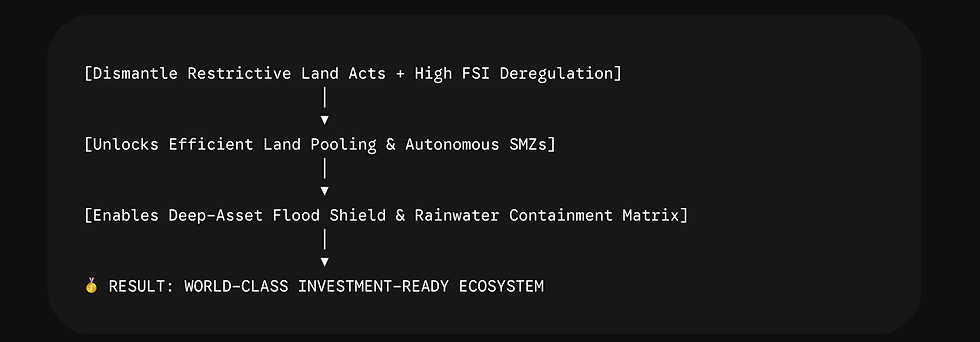
When you pair aggressive FSI deregulation (allowing hyper-dense vertical towers) with streamlined land aggregation laws, the unit economics of Land Pooling completely flip. Developers can build high-value vertical clusters, leaving massive ground-level footprints completely open to be engineered into deep-asset drainage arteries, Dutch-style polders, and advanced rainwater containment basins.
By transforming these regulatory bottlenecks into hyper-progressive, investor-friendly frameworks, Kerala doesn't just clear the path for capital—it builds a best-in-class, climate-resilient economic corridor that sets a global benchmark.
De-Risking the Blueprint: Sourcing the Sovereign Capital
Global institutional funds—Sovereign Wealth Funds, Pension Funds, and global tech syndicates—do not avoid complex environments. They avoid unpredictability.
When Kerala presents a fragmented map of tiny, uncoordinated municipalities, capital glides right past us. But when we present a single, predictable, 50-year spatial roadmap backed by a 350+ km/h transit spine, the risk profile changes entirely.

To fund this transformation without straining the state treasury or triggering land acquisition gridlocks, we must deploy two financing mechanisms:
Citizen-Ownership via Land Value Capture (LVC) & Pooling: Legally converting local landowners into equity shareholders in our infrastructure corridors. Instead of being displaced by eminent domain, citizens become direct, lifelong beneficiaries of the compounding land value. Citizen-ownership effectively neutralizes the legacy friction of land protests.
Green Resilience Bonds: Sourcing low-cost international institutional capital specifically earmarked for dual-purpose Dutch-style drainage networks and sustainable maritime energy hubs.
Path Forward
Kerala stands at a unique historical crossroads. We can continue down the path of fragmented, piecemeal development—spending the next two decades managing a steady urban sprawl while our best minds leave the state.
Or, we can recognise that we hold the human capital of Taiwan, the strategic maritime positioning of Singapore, and the aquatic geography of the Netherlands.
The density is already here on our streets. The global precedent is proven. The political mandate is clear. It’s time to stop building patchwork projects and start executing a world-class metropolitan state.
What are your thoughts on shifting Kerala's planning from small municipal layouts to autonomous, engineered regional clusters? Let's discuss in the comments below.


For tech focus: consider biotech - especially creating easy pathways for early/late stage clinical trials given kerala’s healthcare capabilities and eventually move to discovery/pre-clinical work as well. Get more Pharma GCCs to expand footprint in Kerala. Most parts of the semi conductor value chain may be more capital intensive compared to biotech.
Very well written article. The coparisons made are truly apt.