The K-GBA Master Roadmap: Transforming Kerala into India’s First Polycentric Eco-Megapolis (2030-2060 and beyond)

Our opening diagnostics exposed a brutal structural reality: Kerala’s ₹5.07 lakh crore fiscal crisis is not an unfixable spending problem - it is a foundational failure in our spatial design layout. By forcing a land-scarce, monsoon-heavy geography to spread flat across the ground via archaic $1.5x Floor Space Index (FSI) limits, our planning systems have legally mandated infrastructure paralysis, intense social friction, and extreme environmental vulnerability.
To break this cycle, we must transition from the state's traditional five-year short-term planning loops to a multi-decadal, phased architectural roadmap. We must stop trying to force hyper-growth into a single, congested, sprawling hub like Bengaluru or Chennai. Instead, we must deploy a global blueprint that perfectly matches Kerala’s linear geographic reality: China’s Guangdong-Hong Kong-Macao Greater Bay Area (GBA).
The Spatial Paradigm: The 56k GBA vs. The 39k Kerala Canvas
The traditional 20th-century urban model dictates that an economy must have a single, ultra-congested "downtown" core surrounded by decaying suburbs. The GBA completely shattered this rule by connecting 9 mainland cities with Hong Kong and Macao into a unified economic cluster. It broke the old rule that a city has to have a single centre, turning the entire region into a seamless "One-Hour Living Circle" of massive productivity.
When you look at Kerala through this lens, our entire state is not a collection of fragmented administrative districts—it is a single, pre-packaged, 39,000 square kilometre linear megapolis.
Macro Scale Comparison: GBA vs. Kerala
Spatial Metric | China's Greater Bay Area (GBA) | The Proposed Kerala-GBA (K-GBA) |
Total Geographic Area | ~56,000 km^2 | ~39,000 km^2 |
Development Pattern | Multi-Core Polycentric Cluster | Linear, Evenly Distributed Base |
Core Infrastructure Weld | Hong Kong-Zhuhai Express Rail / Mega Bridges | 350+ km/h Multi-Modal Transit Spine |
Economic Growth Model | Decoupled Regional Specialisations | Off-Balance-Sheet Land Value Capture (LVC) |
Zoning Strategy | Strict Wetland & Green Core Preservation | 15/85 Vertical Density & Eco-Equilibrium |
Breaking the 1967 Trap
Why has Kerala been held back? For decades, our urban centres have been strangled by outdated regulatory models. As detailed in our diagnostic on The 1967 Trap: Urban Planning in Kochi, the state has historically applied restrictive zoning laws originally drafted for a bygone era. This artificial capping of vertical growth has systematically prevented our cities from functioning as high-velocity economic engines, turning them into scattered, low-density settlements instead. The K-GBA layout explicitly breaks this historic bottleneck.
Our high population density is not a crisis to be managed; it is an elite, pre-packaged structural asset. Because our people are already evenly distributed across a 590 km coastal strip, we do not have to endure the trauma of bulldozing old neighbourhoods to build mega-cities from scratch. We simply need to weld our existing communities into a highly synchronised, high-velocity network. This is how we anchor a long-term transition toward a hyper-productive, sovereign-grade economic output, mapping out the initial trajectory of Kerala 2100: The $4 Trillion Dream.
PHASE 1: 2030 HORIZON
Establishing the 3 Metropolitan Authorities & Land-Pooling Pilots
Focus: Statutory, legal, and regulatory groundwork to weaponise airspace as currency.
Before laying a single track of high-speed rail, we must reset the state's financial baseline. With just 1.34% of GSDP left for capital expenditure, the regular treasury is trapped in an exhausting cycle of survival—spending 262 days a year in RBI Ways and Means Advances and 84 days in emergency overdrafts. Local bill clearance limits at district treasuries have collapsed from ₹5 crore down to a restrictive ₹10–25 lakh threshold just to keep basic services active.

1. The KIIFB Liquidation & Debt Reset
The state will immediately execute a clean corporate carve-out of the legacy Kerala Infrastructure Investment Fund Board (KIIFB). Outstanding market liabilities totalling an unmet ₹21,000 crore will be ring-fenced. The Finance Department will take over the debt servicing directly via lower-cost regular state loans, instantly stopping the high-interest off-budget drain.
Simultaneously, we will amend the legacy KIIF Act to halt the automatic diversion of 50% of Motor Vehicle Tax and the Petroleum Cess into KIIFB's escrow accounts, flowing these streams directly back to the Consolidated Fund to solve our daily treasury cash management triage.
The elite intellectual assets—including KIIFB’s Institutional Finance Group, its Technical Inspection Wing, and its advanced Spatial Project Monitoring System (SPMS)—will be extracted and absorbed directly into our new Corridor SPV to enforce world-class development standards.
2. The Three Metropolitan Authorities
The state will pass statutory frameworks creating three distinct parastatal bodies: the Malabar Development Authority (North), the Cochin Logistics Command (Central), and the Travancore Governance Commission (South). This structural approach realises the vision laid out in From "One Big Village" to Three Mega-Metros: The Triad Strategy for Kerala. These bodies will operate with independent regulatory and zoning powers, bypassing localised municipal bottlenecks and replacing the legacy patterns exposed in The Missing Metropolises: Why Scattered Development Is Strangling Kerala's Global Potential.
3. Launching 10.0x FSI Equity Land Pooling
Traditional infrastructure funding fails in Kerala because of Eminent Domain—forcibly buying out land triggers endless litigation, localised protests, and painful multi-year delays from families defending their ancestral territorial footprint. The state is forced to pay astronomically inflated acquisition costs upfront, while private speculators hoard the surrounding land and capture 100% of the economic windfall.
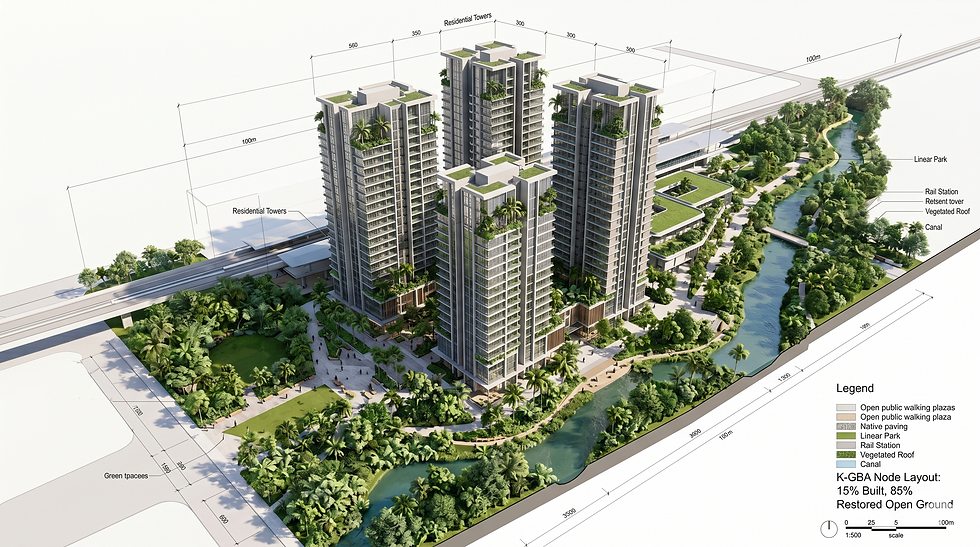
Instead, the authorities will launch voluntary High-FSI Equity Land Pooling pilots at three critical transit junctions. Landowners will voluntarily surrender fragmented parcels into a unified Sovereign Land Pool. The moment the land is pooled, the Corridor SPV applies a radical statutory variance, lifting the FSI ceiling from its flat baseline up to a hyper-dense $10.0x vertical ceiling.
The Structural Shift in Land Economics
Feature | The Broken Eminent Domain Model | The K-GBA Equity Land Pooling Engine |
Financial Impact on State | Massive, debt-funded upfront capital drain | ₹0 upfront cost; completely self-funding |
Impact on the Citizen | Forcible displacement, loss of ancestral roots | Stays on-site as a wealthy corporate shareholder |
Asset Value Realisation | Swallowed entirely by private land speculators | 5x to 10x value explosion returned directly to the owner |
Zoning Footprint | Flat, sprawling concrete carpet | Compact, ultra-dense vertical needles |
By allowing developers to build vertically, the total buildable square footage increases exponentially on the exact same ground footprint. Even though the original landowner receives a smaller physical footprint back (typically a 30% reduction to allow for corridor tracks and green buffers), the radical vertical rights increase their localised land asset value by 5x to 10x. The citizen is no longer a displaced casualty of development; they become a wealthy, asset-backed, dividend-earning corporate shareholder of the corridor's future economic velocity.
PHASE 2: 2040 HORIZON
High-Velocity Infrastructure & Utility Overhauls
Focus: Welding the state together through transit and erasing the ₹78,851 Crore parastatal utility bleed.
1. The One-Hour Living Circle
Backed by the independent asset reserves generated from the 2030 vertical pooling pilots, the state will issue international, ring-fenced Green Resilience Bonds to construct a 350+ km/h high-speed multi-modal transit spine.
This infrastructure turns our linear geography from a logistical bottleneck into our ultimate competitive corridor. Rather than treating this as an isolated luxury line, our blueprint draws inspiration from advanced European spatial logistics. As detailed in Beyond SilverLine: The German Model, we are deploying a hyper-integrated, multi-modal regional express network that maximises daily accessibility for all socio-economic strata. A knowledge worker can live in a serene, green pocket of Alappuzha or Wayanad, hop on the transit spine, and walk into an AI design lab in Kozhikode or a maritime fintech office in Kochi within 45 minutes.
2. Plugging the ₹78,851 Crore Utility Bleed
We cannot host a world-class economy while the state treasury is continuously drained just to keep inefficient parastatals on life support. Active state PSEs are bleeding a staggering ₹78,851 crore in accumulated losses, with just three entities—the Kerala State Road Transport Corporation (KSRTC), the Kerala Social Security Pensions Limited (KSSPL), and the Kerala Water Authority (KWA)—responsible for 72% of this massive net loss.
We will aggressively transition from broken production subsidies (writing blank checks to corporate boards to cover inefficiencies) to consumption-based subsidies. Subsidies targeted for low-income beneficiaries will be paid directly to the citizens via direct digital transfers. The parastatals will be forced to operate as lean, commercially viable corporate entities competing in an open market.

The UCCC Merger: To instantly reduce the state's retail subsidy burden, the highly profitable Kerala State Beverages Corporation (Bevco) will be legally merged with the loss-heavy Civil Supplies Corporation (Supplyco) into the Unified Civil Commercial Corporation (UCCC). Under a unified balance sheet, Supplyco’s losses on subsidised essential commodities are legally offset directly against Bevco’s heavy commercial liquor profits. This structural consolidation instantly lowers the entity's overall corporate tax outgo, completely erasing the need for the state government to write direct budgetary checks to keep Supplyco alive.
The KSEBL Overhaul: KSEBL sits on a negative net worth of ₹35,149 crore, structurally broken because it relies on expensive external power purchases for over 56% of its total costs. We will enforce an immediate statutory order forcing KSEBL to remit 100% of collected electricity duties back to the treasury and replace political chairmanships with professional, market-selected executives holding fixed 3-to-5-year tenures. To fuel sunrise industries, we will open our power sector to private investment, aggressively scaling clean energy through 6,000 MW of solar capacity and 8,000 MW of pumped hydro-electric storage.
The KSRTC Asset-Light Pivot: KSRTC carries a negative net worth of ₹19,820 crore and owes ₹11,678 crore in accumulated arrears back to the government. KSRTC will transition to an "Asset-Light" model, franchising out high-frequency, loss-making routes to private electric fleet operators under state-regulated fare caps. Simultaneously, KSRTC's massive underutilised urban land plots and depots will be monetised through our high-FSI vertical land pooling framework, generating independent revenue streams to clear legacy employee pension liabilities.

3. Subsurface Climate Shield Upgrades
Every major high-density transit node constructed will feature integrated subsurface water-management networks. These Dutch-style polders and deep containment basins will absorb intense monsoon runoff effortlessly, safeguarding the surrounding high-value vertical real estate assets.
PHASE 3: 2050 HORIZON
The 3 Specialised Metropolis Clusters
Focus: Maturity of regional specialisations and deep industrial integration.
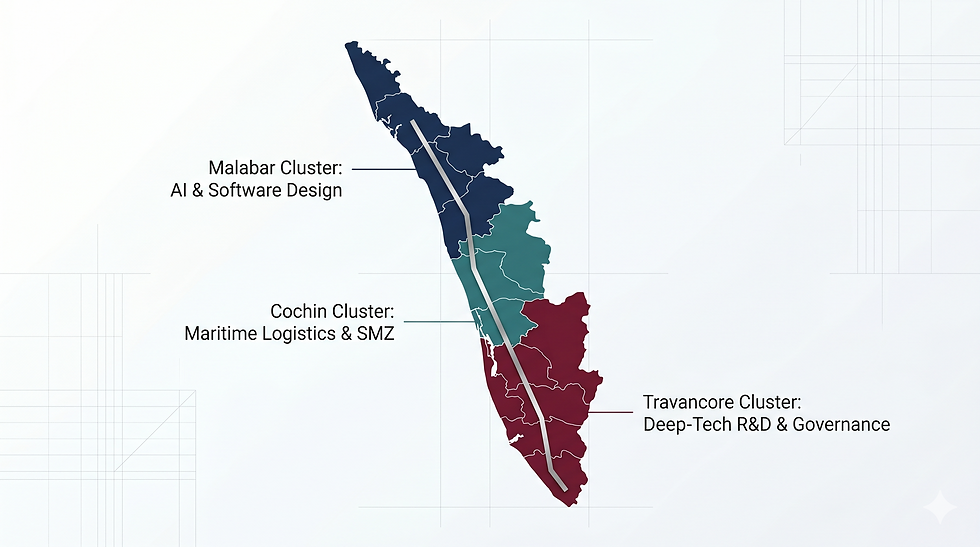
The GBA became a global juggernaut because its cities stopped competing with each other and began operating with a strict division of labour: Hong Kong commands finance, Shenzhen dominates hardware innovation, and Guangzhou drives manufacturing. To unlock matching hyper-productivity, the K-GBA framework legally restructures Kerala into three specialised sovereign economic engines:
The K-GBA Regional Division of Labour
Cluster Node | Geographic Core | Macro Economic Specialisation | Global GBA Parallel |
💻 Malabar Hub | Kozhikode / Kannur / Kasaragod | AI Architecture, Software Design, Advanced Agro-tech, Precision Light Manufacturing | Shenzhen: Hyper-paced, high-velocity innovation ecosystem |
🚢 Cochin Hub | Kochi / Alappuzha / Thrissur | Global Maritime Logistics, Reclaimed Island SMZs, International Fintech, Deep-Water Transhipment | Guangzhou: Deep-water shipping berths and international trade portals |
🛡️ Travancore Hub | Trivandrum / Kollam | Deep-Tech Foundries, Space Systems, Thorium Energy Research, Sovereign Wealth Structuring | Hong Kong: Legal, administrative, and sovereign asset anchor systems |
The Geopolitical Trinity Integration
This structural distribution of labour directly adapts the operational mechanics analysed in The Geopolitical Trinity: How Kerala Can Fusion-Replicate Taiwan, Singapore, and the Netherlands. By blending Taiwanese deep-tech foundry precision within the Malabar Hub, Singaporean-style maritime regulatory efficiency within the Cochin Hub, and Dutch-grade climate-resilient spatial layouts across the terrain, the K-GBA framework builds an unassailable domestic economic container.

The Malabar Hub Narrative: Capitalising on a completely stable energy grid, the northern cluster matures into a hyper-paced innovation ecosystem. It serves as a global hub for boutique semiconductor chip design, spatial computing, and AI data centres.
The Cochin Hub Narrative: Leveraging its geographic proximity to global trade lanes, this cluster integrates the deep-water transhipment assets of Vallarpadam and Vizhinjam into an LVC-funded, high-density industrial corridor. Reclaimed island SMZs operate under specialised commercial courts, attracting massive international maritime fintech and freight routing monopolies.
The Travancore Hub Narrative: Operating as the sovereign administrative and research anchor, the southern cluster leverages Kerala’s immense coastal monazite sand deposits. It transforms into a global epicentre for Thorium-based clean energy research, turning a raw mineral resource into a multi-billion-dollar clean technology monopoly.
PHASE 4: 2060 and beyond VISION
The Unified Polycentric Eco-Megapolis
Focus: Full spatial equilibrium - the ultimate optimisation of economy and ecology.
The ultimate point of failure for traditional Indian urban planning is localised political bickering and shifting electoral mandates. By 2060, the K-GBA Unified Coordination Commission will have successfully enforced an unalterable 50-year master planning layout. This statutory body operates completely insulated from shifting five-year electoral cycles, ensuring that our infrastructure contracts, zoning laws, and environmental boundaries remain ironclad across generations.
The 15/85 Spatial Dual Dividend
By 2060, Kerala will have permanently halted horizontal urban sprawl. Because human commercial activity and real estate are completely consolidated into hyper-dense vertical needle towers, we realise a historic spatial optimisation:

By compacting our economic hubs vertically, we leave up to 85% of our land footprint fully reclaimed, open, and preserved.
Ecological Equilibrium
The Western Ghats, our local agricultural fields, and our fragile backwater ecosystems are legally and physically locked away from real estate encroachment. The pristine natural terrain acts as the primary carbon sink and natural flood-defence grid for the state. High technology and undisturbed tropical ecosystems thrive hand-in-hand.
Sovereign Financial Insulation
To attract deep-market global liquidity from international pension syndicates and Sovereign Wealth Funds, this capital cannot touch the mainland budget. The state's regular treasury operates under severe structural stress, carrying ₹48,733 crore in inherited payment liabilities. If global investors believe their capital will be diverted to cover routine committed salary or pension expenses, they will walk away.
Therefore, the Corridor SPV will operate behind an unassailable legal and accounting firewall. All transactional velocities, ground leases, and bond inflows will completely bypass the regular treasury. They will flow directly into Irrevocable Escrow Accounts managed by international banking trustees. This legal architecture guarantees that 100% of investor capital is deployed exclusively to build out the high-speed infrastructure and service bond yields - completely insulated from mainland administrative pressures or shifting five-year electoral cycles.
Kerala stands as a debt-free, self-funding global economic superpower.

The Financial Ledger Behind the 10-Year Node Yield
To prove to the macroeconomists reading this series that this is not speculative fiction, let's look at the hard mathematical baseline for a standard 100-Hectare Transit-Oriented Development (TOD) Core Node within the K-GBA framework:
The Spatial Gain: By transitioning from a flat 1.5x FSI to a vertical 10.0x FSI, the total realisable built-up area on the same land footprint expands from 1.5 million m^2 to 10.0 million m^2.
The Retained SPV Reserve: The Corridor SPV retains 30% of the newly unlocked vertical commercial rights (3.0 million m^2) completely for itself. At a conservative post-regulatory vertical space valuation of ₹65,000 per m^2, this creates a massive ₹19,500 crore asset reserve held directly by the SPV.
The Cash Flow Horizon: The SPV deploys this independent asset reserve to back the issuance of long-term, international Green Resilience Bonds, raising the ₹4,500 crore required to build the transit node and subsurface climate polders without a single rupee of taxpayer debt. Once the high-density ground leases go live, they generate a projected ₹2,800 crore in annualised rental inflows, yielding a sovereign-grade project IRR of 22.4%.
The old playbook of debt-funded consumption is officially bankrupt. The global capital is waiting on the sidelines, and the engineering blueprints are proven. It’s time to rewrite our spatial rules, unbox our economic DNA, and build the K-GBA.
If space is the new currency, which primary high-speed transit node in Kerala should host our very first 10.0x FSI vertical land pooling pilot? Let’s debate the spatial economics in the comments below.


Comments