Kerala Land Liberation Act - Overcoming Artificial Scarcity & The CIDCO-Amaravati Pooling Hybrid

Introduction: Confronting the Artificial Scarcity Trap
Kerala’s contemporary economic discourse is fundamentally limited by a collective psychological illusion: the myth of absolute land scarcity. With an overall geographic area of 38,863 square kilometres and one of the highest population densities in India, the state has historically used its restricted usable land mass as a defensive shield to excuse industrial stagnation. The true bottleneck is not geographic; it is regulatory.
Decades of defensive, hyper-fragmented zoning, antiquated mid-century land-use acts, and sub-optimal density parameters have engineered an artificial scarcity trap. This structural choking of space drives real estate acquisition costs to levels that repel global capital, completely stalls the organic formation of industrial clusters, and forces Kerala’s elite educated demographic to migrate out of the state in a chronic, multi-generational brain drain.
The mid-2026 Kerala state budget arrives at a critical fiscal junction. Balancing a massive structural revenue deficit of over ₹35,355 crore, capital expenditure that has dropped to historic lows, and intense debt liabilities, traditional tax-and-spend welfare models have officially hit a wall. Off-budget borrowing strains mean the state cannot borrow or tax its way into becoming a high-tech powerhouse. We must leverage our spatial assets.
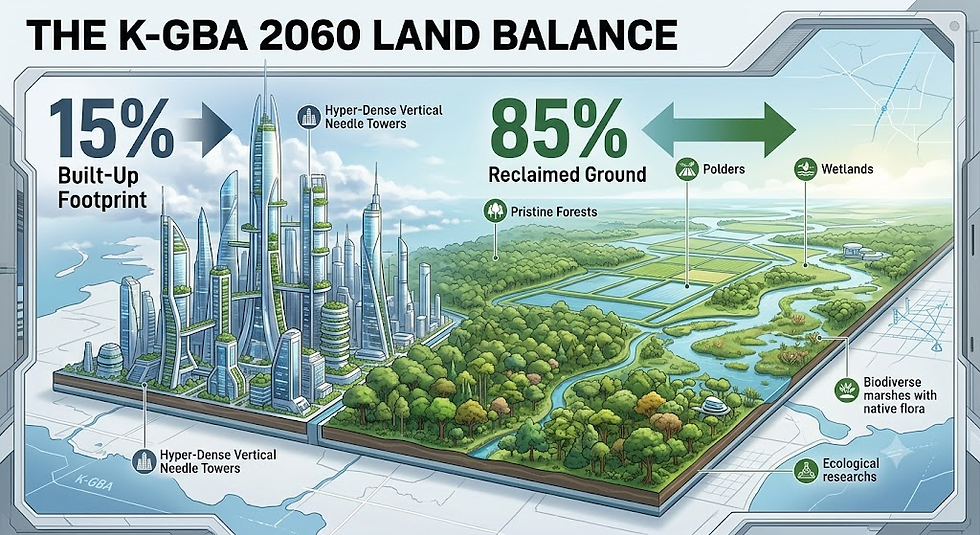
By executing a bold, 5-year regulatory overhaul, the state can transition into a hyper-dense Polycentric Metropolitan State—the Kerala Greater Bay Area (K-GBA). This framework consolidates economic activity vertically into tightly zoned, high-FSI urban clusters, while permanently locking away the remaining 85% of our pristine geography for ecological preservation and high-value tourism assets. The path from survival to global monopoly begins with liberating the land.
1. The 15/85 Spatial Dividend: Vertical Growth as an Ecological Rescue Mission
To preserve the fragile environmental baseline of our Western Ghats and our continuous backwater networks, horizontal urban sprawl must be legally and structurally halted. The K-GBA implementation playbook establishes a radical 15/85 Spatial Dividend: compacting 100% of the state's heavy industrial, manufacturing, commercial, and high-density residential footprint into exactly 15% of the total land mass across designated transit corridors.
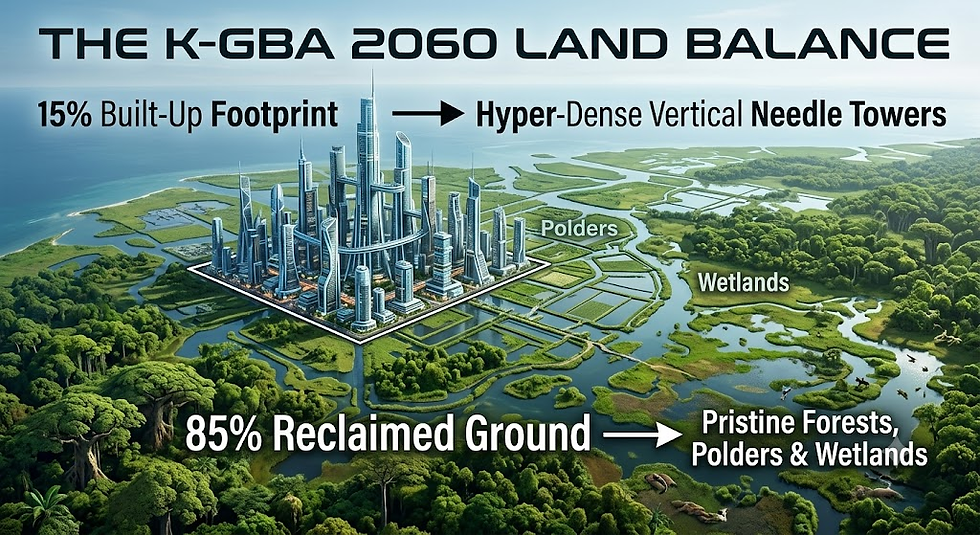
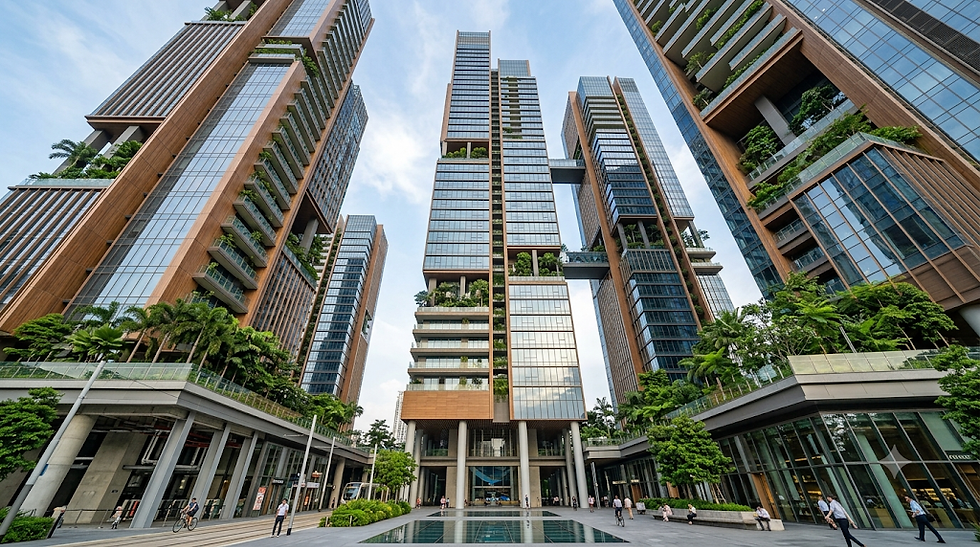
High FSI (5.0–8.0+) and dense vertical needle towers are often misconstrued as an environmental hazard to a populace deeply protective of Kerala's natural landscape. The K-GBA framework reframes vertical real estate not as a commercial luxury, but as the ultimate act of environmental preservation.
Horizontal sprawl is the true ecological villain, cutting down our forest canopy, filling up the wetlands, and muddying the backwaters. By building up, we actively liberate the ground. Going vertical allows us to enforce an absolute Ecological Redline, preserving 85% of Kerala as pristine, untouched natural terrain where ecosystems can breathe.
Achieving this requires an immediate, statutory expansion of Floor Space Index (FSI) allocations within our primary urban cores, completely discarding old limits:
The Transit FSI Matrix: Mandate statutory baseline shifts to an FSI of 5.0–8.0 in mixed-use town centres, scaling to 8.0+ directly along transit hubs and metro station radii.
Registration Tax Compression & Inclusionary Zoning: While the mid-2026 budget extends a 4% concessional stamp duty to luxury layouts, the K-GBA framework slashes property registration taxes by 50% exclusively for vertical, multi-family residential apartments near transit corridors. To prevent gentrification, any high-density developer utilising the 8.0+ FSI bonus must allocate a mandatory 20% of their built-up area for affordable workforce housing and subsidised starter-studios for local graduates, ensuring our tech corridors remain economically integrated human ecosystems.
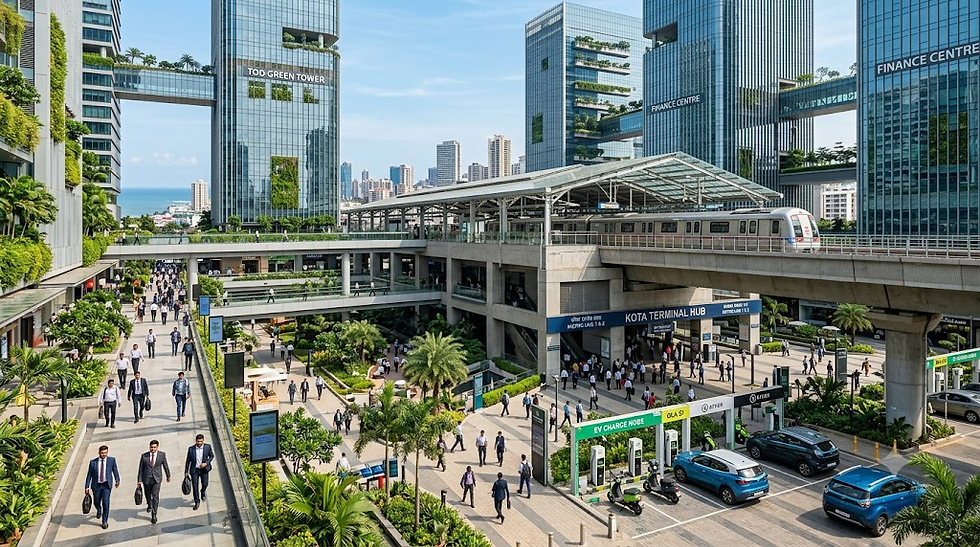
Sub-Surface Utility Rights & The Congestion Tax
Hyper-concentrating thousands of engineers, data centres, and residents onto tight vertical needles creates intense, localised infrastructural strain. To prevent a catastrophic micro-grid collapse or sewage backlogs at the base of these towers, high-density vertical clearance is legally tied to Sub-Surface Utility Rights. Developers using the FSI bonus cannot rely on city grids; they are contractually mandated to engineer closed-loop decentralised sub-surface graywater recycling plants and solid-waste vacuum systems natively within the building's deep foundations. Furthermore, a Hyper-Node Congestion Levy will be collected from non-electric private vehicles entering the 15% nodes, with 100% of the proceeds legally locked into upgrading mass transit, water metro and electric bus feeders right at the node's base.
2. Dismantling the 1967 Trap: Amending the Land Reforms Act
The definitive historical barrier to institutional industrialisation in Kerala is the Kerala Land Reforms Act, 1963 (fully enforced by 1970), which strictly caps individual or corporate ownership of non-plantation land at 15 to 20 acres. As unboxed in our policy brief "The 1967 Trap," while this legislation was originally engineered to ensure agrarian social equity and eradicate feudal landlordism, its survival into the deep-tech era has made it legally impossible for private enterprise to aggregate the contiguous land parcels required for semiconductor foundries, advanced hardware parks, or large-scale aerospace component assemblies.
The K-GBA framework introduces an immediate legislative amendment: The Accelerated Special Economic Enclosure Act. This amendment completely exempts designated private tech park developers, semiconductor design consortia, and global collaboration centre operators from the 20-acre ceiling rule, provided the aggregated land is located within the verified K-GBA growth corridors. When global enterprises look to deploy capital, they require contiguous, unencumbered space. Amending this act does not mean dismantling land equity; it means designating clear economic boxes where industrial-scale job creation can legally exist to stem the outbound migration of our youth.
The Use-It-Or-Lose-It Anti-Hoarding Clause
Removing the 20-acre ceiling runs the risk of inviting large real estate cartels to buy up massive tracts of land simply to hold them as speculative, non-productive assets. To crush speculative land banking and property inflation, the Accelerated Special Economic Enclosure Act includes a strict, time-bound Use-It-Or-Lose-It Statutory Clause. Any corporate entity aggregating more than 20 acres inside the K-GBA corridors must hit clear development milestones: physical construction must commence within 18 months of land acquisition, and commercial operations must begin within 36 months. Failure to hit these milestones triggers an automatic 300% punitive property tax scale or immediate reversion of the surplus acreage back to the K-GBA land bank pool, ensuring land remains a highly productive workspace rather than a dead speculative asset.
3. The Plantation & Fallow Land Re-Zoning Playbook
Unlocking land equity requires looking directly at the underutilised corporate land holdings currently locked up in legacy agricultural categories. Large-scale plantation estates occupy massive swaths of the state's interior foothills, while thousands of hectares of abandoned paddy fields lie fallow across the coastal plains due to shifting labour dynamics and unviable agricultural economics.
The K-GBA land conversion playbook introduces a friction-free, programmatic re-zoning mechanism:
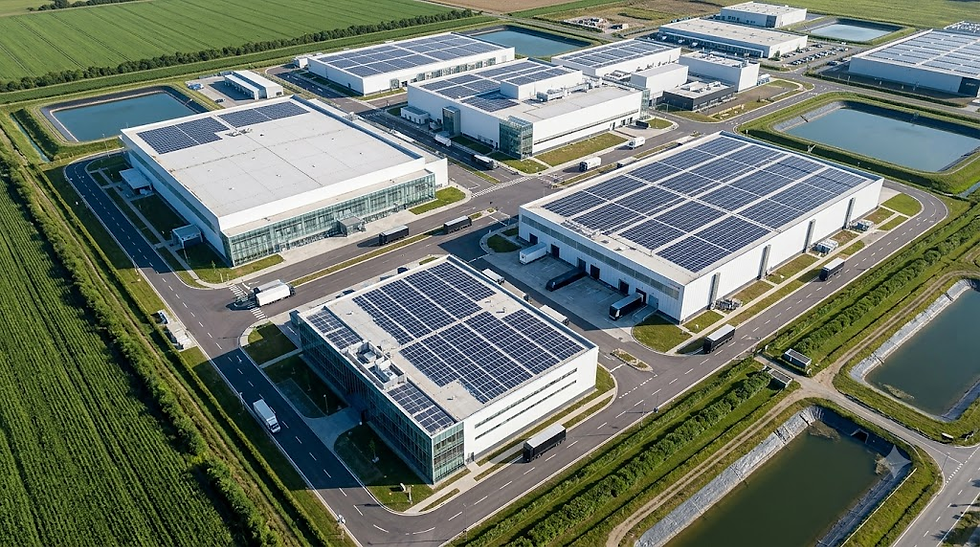
Plantation Land Liberalisation: Create an automated fast-track mechanism to permit the conversion of sub-optimal rubber, tea, coffee, and cardamom plantations for non-agricultural industrial usage, strictly targeted in non-touristy, non-ecologically fragile zones. If a plantation estate’s commodity yield falls below a defined economic threshold, the holder can legally convert up to 30% of the acreage into zero-emission private tech parks or clean-tech assemblies without facing bureaucratic litigation.
Fallow Paddy Field Repurposing: Establish a localised database of abandoned or structurally unviable paddy fields that have lacked agricultural yield for over a decade. These specific parcels will be automatically re-zoned for clean-tech manufacturing enclosures, micro-logistics hubs, and green data centres, turning stagnant land assets into highly productive capital magnets.
4. The 1,000-Acre CIDCO-Amaravati Hybrid Land Pooling Framework: A Generational Wealth Engine
When public infrastructure requires massive contiguous land accumulation, traditional eminent domain land acquisition models invariably trigger protracted legal battles, localised political friction, and prohibitive upfront cost capital demands on an already strained state treasury. The K-GBA completely moves away from aggressive state acquisition and introduces a citizen-shareholder model combining Navi Mumbai’s land-monetisation SPV (CIDCO) model with Amaravati’s fractionally returned land-pooling framework.
Terms like "land accumulation" and "enclosures" can sound alarming to smallholders, invoking fears of industrial land grabs and displacement. The K-GBA framework explicitly reframes land pooling as a structural tool for social mobility. Kerala’s typical smallholdings (often under 50 cents or 1 acre) inevitably fragment across generations, leaving families asset-rich on paper but cash-poor in reality. Pooling converts an unproductive, illiquid plot of soil into a hyper-premium, high-yield commercial asset. The citizen doesn't lose their roots; they become an equity-holding corporate landlord in a world-class smart city, receiving multi-generational dividend yields that secure their children's future.
────────────────────────┘
Under this framework, the state will incorporate corridor-specific Special Purpose Vehicles (SPVs) to execute 1,000+ acre township developments (modelled on the advanced KWIN City template). Local landowning citizens voluntarily surrender their fragmented, low-yielding agrarian parcels to the SPV without any cash changing hands, avoiding immediate fiscal outlays from the state budget.
The SPV takes this consolidated 1,000-acre canvas, installs world-class utility backbones, optical fibre grids, wide arterial roads, and high-FSI vertical zoning parameters. Once the territory is urbanised, the SPV legally returns 35% to 40% of the newly developed, hyper-premium commercial and residential plots back to the original landowners. Because the land value has exponentially compounded due to the infrastructure infusion, the citizens’ downscaled fractional holding is worth significantly more than their original acreage.
The Local Talent Equity Quota
Suddenly, massive land wealth can inadvertently create a passive "rentier economy" where landowners stop engaging in productive labour, while incoming high-value deep-tech jobs are filled entirely by external talent—triggering local friction. To bridge this wealth-talent gap and neutralise resistance, the pooling SPV charter mandates a Local Talent Equity Quota. Global tech conglomerates leasing land from the pooling SPV receive a 10% corporate state tax rebate only if they actively run subsidised, high-intensity upskilling bootcamps for the children of the original landowners. By transforming the agrarian generation’s descendants from passive rent-collectors into competitive deep-tech hardware operators, we align long-term community growth with vertical industrial scale.
The Homegrown Precedent: The CIAL Model
This is not a foreign corporate experiment; it is rooted in Kerala’s greatest structural success story: CIAL (Cochin International Airport Limited). Kerala pioneered the world's first public-private-diaspora partnership airport by pooling land, giving affected locals equity shares, and turning land-providers into dividend earners. The K-GBA land pooling SPV simply scales the trusted, homegrown CIAL framework from a single airport into an entire regional economic spine.
5. The Local Panchayat Infrastructure Dividend
Kerala has a highly decentralised governance culture—the legacy of the historic People's Plan Campaign. Local Panchayats and municipalities will instinctively push back against a centralised authority like KGIDA encroaching on their zoning turf. To ensure absolute alignment and localised political buy-in, the K-GBA introduces a practical financial mechanism: The Local Infrastructure Dividend.
Under this statutory rule, a fixed 12% of the capital gains and recurring lease revenues generated by the 1,000-acre land pooling SPVs will bypass the state treasury and flow directly back to the local Panchayat’s public accounts. This capital is legally earmarked for:
Building state-of-the-art local primary and secondary public schools.
Upgrading community health centres with specialised diagnostic infrastructure.
Constructing world-class walkability networks, parks, and localised civic amenities.
By tying the macro success of the vertical tech nodes directly to the micro-funding of local municipal assets, local political actors and community members become eager co-executors of the K-GBA layout, transforming regional friction into collaborative execution.
6. Commercial & Nightlife Deregulation: Courting Global Talent
A high-tech economy cannot function within a socio-commercial ecosystem that systematically shuts down at 9:00 PM. To court global engineers, multinational research directors, and venture capital syndicates, our metropolitan areas must offer world-class urban lifestyle amenities. Our top-tier human capital continuously flees to Bangalore, Chennai, and Dubai because our domestic urban spaces lack the lifestyle infrastructure required by a modern workforce.
Pivoting on the mid-2026 budget’s realistic sales tax adjustments for low-strength alcoholic beverages, the K-GBA playbook decouples commercial retail licensing from moralising regulatory frameworks:
Universal 24/7 Zoning: Grant automatic, unconditional 24/7 operational clearances for all commercial retail spaces, co-working enclosures, dining facilities, and micro-logistics hubs located within the designated vertical nodes of Kochi, Kozhikode, and Thiruvananthapuram.
Liquor License Liberalisation: Completely overhaul the restrictive hospitality licensing architecture. High-FSI mixed-use zones, tech-enclosure hotels, and certified entertainment corridors will receive streamlined, multi-tier entertainment and consumption permits. By actively deregulating nightlife and transforming our city centres into vibrant, safe, round-the-clock cultural zones, Kerala can seamlessly compete with the lifestyle appeal of global hubs.
7. The Singular K-GBA Spatial Dashboard: Bypassing Bureaucracy
The ultimate operational friction for private capital entering Kerala is administrative uncertainty. Replicating the success of Hyderabad’s automated single-window BuildNow framework, the K-GBA replaces manual, multi-layered department clearances with a singular digital command architecture.
The state will launch an open-access, GIS-mapped interactive platform that integrates all spatial variables onto a single screen. Any international investor or local citizen can log in to instantly view:
Zoning & FSI Allocations: Click any block in Kochi or Thiruvananthapuram to find its exact permissible FSI, height allowances, and mixed-use categories.
Algorithmic Conversion Eligibility: Drop a survey number to check if a fallow paddy field or plantation tract qualifies for industrial tech park conversion under the new automated codes.
Real-Time Tracking Enclosures: View the exact ledger of ongoing land-pooling allocations, infrastructure buildout milestones, and pending spatial approvals.
By moving urban planning out of closed administrative files and onto a transparent, algorithmic dashboard, we eliminate bureaucratic delays entirely, establishing a frictionless business ecosystem that matches the standard of the world's leading economic zones.
Strategic Implementation Roadmap (Next 12 Months)
Phase | Timeline | Primary Operational Deliverable | Responsible Public Agency |
Phase I | Months 0 - 3 | Draft and introduce the Accelerated Special Economic Enclosure Bill to amend the 1963 land ceiling parameters for tech manufacturing. | Department of Law / Land Revenue |
Phase II | Months 3 - 6 | Launch the beta version of the Unified K-GBA Spatial Dashboard covering the primary Kochi-Angamaly transit spine. | Kerala State IT Mission (KSITM) |
Phase III | Months 6 - 9 | Incorporate the first regional K-GBA Land Pooling SPV and identify the initial 1,000-acre pilot tract along the Palakkad-Thrissur corridor. | Department of Urban Affairs / PPP Board |
Phase IV | Months 9 - 12 | Standardise 24/7 universal zoning clearances and roll out the streamlined hospitality licensing permits across all tier-1 urban centres. | Excise and Home Department |
Executing the Paradigm Shift
The financial diagnostic presented by the mid-2026 budget leaves no room for hesitation: the traditional playbook of running a state on debt-funded consumption has hit its absolute structural limits. We can no longer treat land as a static, restricted commodity to be guarded by protective mid-century regulations. Land is an active infrastructural canvas that must be optimised to generate value, fund public utilities, and anchor the global industries of the future.
By combining vertical spatial density with aggressive land-pooling SPVs and cutting-edge digital administrative clearance engines, the K-GBA framework converts our unique land constraints into a highly optimised asset. The engineering blueprints are validated, and the off-balance-sheet financial engines are set. It is time to pass the Land Liberation Act, launch the corridor SPVs, and physically construct the future of Kerala.
A Question for the Community
To transition Kerala into a high-density vertical megapolis, we must replace restrictive land ceilings with citizen-equity land pooling models. Which specific regional node along our primary transit spines do you believe is most ripe for our first 1,000-acre high-FSI hybrid pooling pilot?
Let us know your thoughts and structural ideas in the comments below.


Comments