The Money Engine - How High-FSI Land Pooling Funds Our Future For Free

Our opening piece re-framed Kerala’s ₹5.07 lakh crore debt crisis not as an unfixable spending problem, but as a spatial design layout failure. But the moment you propose a state-wide, high-velocity transit spine or hyper-dense Special Management Zones (SMZs), the traditional fiscal sceptics will push back with their loudest question:
“Great vision, but the White Paper just proved we only have 1.34% of GSDP left for CapEx. Where is the money coming from?”
The answer is that we are going to stop relying on the state treasury altogether.
To fund the K-GBA Polycentric Megapolis, we are deploying a hyper-progressive financial engine: Land Value Capture (LVC). By rewriting our statutory rules, we can transform space into our primary currency, bypassing the state's borrowing constraints entirely and making our infrastructure self-funding.
1. Winding Down the KIIFB Debt Model
To clear the runway for this new asset-backed model, we must first address the parallel financial engine of the past decade: the Kerala Infrastructure Investment Fund Board (KIIFB).

As the state's financial status paper cleanly demonstrates, KIIFB's original premise—to raise infrastructure capital outside the state budget framework—has been structurally compromised. Recent regulatory and C&AG adjustments mean that KIIFB’s borrowings are now counted directly against the state’s regular Net Borrowing Ceiling, while its independent funding costs sit 1 to 1.5 percentage points higher than regular government loans.
With an unmet loan liability of ₹21,000 crore and a ₹35,000 crore approved project pipeline remaining, the old parastatal model has hit a dead end.

┌─────────────────────────────────────────────
The execution playbook requires a clean corporate carve-out:
The Debt Reset: Ring-fencing legacy liabilities through a Special Purpose Vehicle (SPV) liquidation protocol. The Finance Department will take over the debt servicing directly via lower-cost regular state loans, instantly stopping the high-interest off-budget drain.
Ending Revenue Diversion: We will amend the legacy KIIF Act to halt the automatic diversion of 50% of Motor Vehicle Tax and the Petroleum Cess into KIIFB's escrow accounts. These streams will flow directly back to the Consolidated Fund to solve our daily treasury cash management triage.
Extracting the Intellectual Capital: We will cleanly extract KIIFB’s high-performing operational assets—specifically its Institutional Finance Group, its Technical Inspection Wing, and its advanced Spatial Project Monitoring System (SPMS)—and absorb them directly into our new Corridor SPV to enforce world-class development standards.
The Federal Mandate: Aligning with the National LVC Policy
Skeptics will ask if this off-balance-sheet engineering runs afoul of federal fiscal monitoring. The answer is exactly the opposite. In 2017, the Ministry of Housing and Urban Affairs (MoHUA) officially issued the National Land Value Capture Policy Framework. The central directive explicitly commands cash-strapped states to move away from debt-heavy infrastructure funding and deploy structural value capture tools like Transferable Development Rights (TDR), Betterment Levies, and Premium FSI. The K-GBA Corridor SPV isn't bypassing regulations; it is structurally executing New Delhi's own sovereign urban mandate.
2. From Protesters to Shareholders: The Equity Land Pooling Engine
Traditional infrastructure funding fails in Kerala because of Eminent Domain. When the state attempts to forcibly buy out land for a public corridor, it faces endless litigation, localised protests, and multi-year delays from families defending their ancestral territorial footprint. The state is forced to pay astronomically inflated acquisition costs upfront, while private speculators hoard the surrounding land and capture 100% of the economic windfall.
Land Value Capture flips this broken paradigm entirely using High-FSI Equity Land Pooling, a model proven by Hong Kong’s MTR Corporation and Tokyo’s private rail networks.
The Proof of Concept: Real-World Indian Success Stories
The Indian Precedents: Beyond Speculative ModelsIf you think voluntary land pooling cannot scale in India's complex socio-political landscape, look at the domestic precedents: 1. The Amaravati Model (Andhra Pradesh): Despite shifting political tides, the Capital Region Development Authority successfully secured over 33,000 acres of contiguous land from 25,000+ farmers within months without a single major protest or ongoing eminent domain lawsuit. The engine? Landowners voluntarily pooled their land in exchange for reconstituted, high-value commercial plots with advanced infrastructure rights. 2. The CIDCO & NAINA Models (Maharashtra): Navi Mumbai’s rapid expansion successfully bypassed state acquisition costs by returning 40% of developed land back to the original owners, transforming local agriculturalists into wealthy, urban real estate partners. 3. GIFT City (Gujarat): Proof that high-FSI vertical density can successfully exist in a ring-fenced, special financial zone inside India, attracting global institutional capital by decoupling local municipal zoning constraints from macro execution.
──► Sovereign Pool ──► High-FSI Deregulation ──► Asset Shareholder

Instead of the state spending billions it doesn't have to acquire land along our 350+ km/h transit spine, landowners voluntarily surrender their fragmented parcels into a unified Sovereign Land Pool. The moment the land is pooled, the Corridor SPV applies a radical statutory variance, lifting the FSI ceiling from its flat baseline up to a hyper-dense 10.0x vertical ceiling.
By allowing developers to build vertically, the total buildable square footage increases exponentially on the exact same ground footprint. Even though the original landowner receives a smaller physical footprint back (typically a 30% reduction to allow for corridor tracks and green buffers), the radical vertical rights increase their localised land asset value by 5x to 10x.
The citizen is no longer a displaced casualty of development. They become a wealthy, asset-backed, dividend-earning corporate shareholder of the corridor's future economic velocity.
3. The 10-Year Spatial Ledger: The Numbers Behind the Yield
To prove that this isn't speculative fiction, let's look at the financial modelling baseline for a standard 100-Hectare TOD (Transit-Oriented Development) Core Node within the K-GBA framework:
The Spatial Gain: By transitioning from a flat 1.5x FSI to a vertical 10.0x FSI, the total realisable built-up area on the same land footprint expands from 1.5 million m^2 to 10.0 million m^2.
The Retained SPV Reserve: The Corridor SPV retains 30% of the newly unlocked vertical commercial rights (3.0 million m^2) completely for itself. At a conservative post-regulatory vertical space valuation of ₹65,000 per m^2, this creates a massive ₹19,500 crore asset reserve held directly by the SPV.
The Cash Flow Horizon: The SPV deploys this independent asset reserve to back the issuance of long-term, international Green Resilience Bonds, raising the ₹4,500 crore required to build the transit node and subsurface climate polders without a single rupee of taxpayer debt. Once the high-density ground leases go live, they generate a projected ₹2,800 crore in annualised rental inflows, yielding a sovereign-grade project IRR of 22.4%.

Benchmarking the 10.0x FSI Axis. While a $10.0x$ FSI appears radical relative to Kerala's historic baseline, it is already becoming standard practice along high-density transit corridors in India's leading economic engines:
Mumbai's TOD Policy: The Maharashtra government formally approved an FSI of up to 5.0x for areas falling within Transit-Oriented Development (TOD) zones along metro corridors, funded directly by charging developers a premium FSI fee.
Bengaluru's Metro Axis: The Karnataka government utilises a sliding scale of premium FSI along the Namma Metro routes to cross-subsidise network expansions. Given Kerala's uniquely acute geographic constraints, pushing the core transit node nodes to a hyper-dense $10.0x ceiling is simply the logical mathematical scaling of the Mumbai and Bengaluru experiments—maximising vertical volume to preserve 85% of our fragile ecosystem.
4. The Institutional Firewall
To attract deep-market global liquidity from international pension syndicates and Sovereign Wealth Funds, this capital cannot touch the mainland budget.
The state's regular treasury operates under severe structural stress, carrying ₹48,733 crore in inherited payment liabilities. If global investors believe their capital will be diverted to cover routine committed salary or pension expenses, they will walk away.
Therefore, the Corridor SPV will operate behind an unassailable legal and accounting firewall. All transactional velocities, ground leases, and bond inflows will completely bypass the regular treasury. They will flow directly into Irrevocable Escrow Accounts managed by international banking trustees.
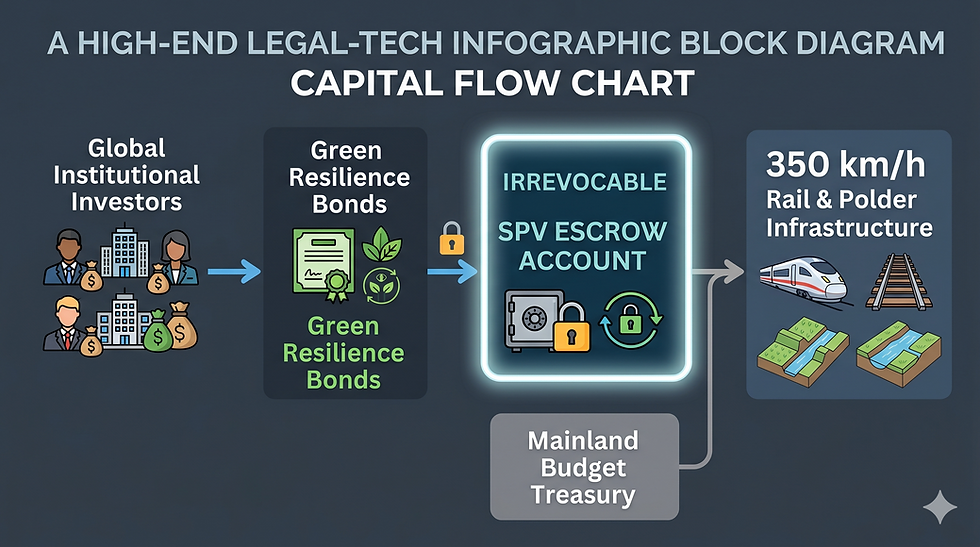
This legal architecture guarantees that 100% of investor capital is deployed exclusively to build out the high-speed infrastructure and service bond yields—completely insulated from mainland administrative pressures or shifting five-year electoral cycles.
We have the spatial blueprint, and we have the financial engine. Now, we must plug the final internal leak on our balance sheet and power the industrial transformation.
In our final piece, Blog 3: The Plug & The Power, we will break down the ultimate restructuring of our public utilities: how we will stop the ₹78,851 crore corporate bleed, transition to consumption-based subsidies, and open up the energy grid to private capital to fuel an unprecedented deep-tech manufacturing boom.
If space is the new currency, which primary high-speed transit node in Kerala should host our very first 10.0x FSI vertical land pooling pilot? Let’s debate the spatial economics in the comments below.


Comments