The Plug & The Power - Fixing the ₹78,851 Crore Utility Bleed for a High-Tech Surge

Our first two pieces re-engineered Kerala's spatial layout and mapped out the off-balance-sheet financial engine needed to fund the K-GBA Polycentric Megapolis without taxpayer debt. But to make this high-speed, vertical future a reality, we have to confront the final structural elephant in the room: the catastrophic fiscal drain of our Public Sector Enterprises (PSEs).
According to Kerala's Fiscal Health: A Status Report, active state PSEs are bleeding a staggering ₹78,851 crore in accumulated losses. Just three entities—the Kerala State Road Transport Corporation (KSRTC), the Kerala Social Security Pensions Limited (KSSPL), and the Kerala Water Authority (KWA)—are responsible for 72% of this massive net loss.
Meanwhile, the Kerala State Electricity Board Limited (KSEBL) sits on a negative net worth of ₹35,149 crore.

We cannot host a world-class economy while the state treasury is continuously drained just to keep inefficient parastatals on life support. It is time to plug the fiscal leaks, rewrite the utility playbook, and unleash the private energy capital required to power Kerala’s deep-tech manufacturing surge.
1. The Death of the Production Subsidy
The foundational error in Kerala's utility management is the production subsidy. For decades, the state has written massive, blank-check subsidies directly to corporate boards to cover up operational inefficiencies, bleeding away resources that should be spent on schools, medical infrastructure, and capital growth.
The K-GBA implementation playbook completely eliminates this broken paradigm. We are transitioning from production-based subsidies to consumption-based subsidies.
Under this model, the state will stop funding utility companies to absorb their corporate cash losses. Instead, subsidies targeted for deserving, low-income beneficiaries will be paid directly to the citizens via Aadhaar-linked Direct Benefit Transfers (DBT).
The utility parastatals will be forced to operate as lean, commercially viable corporate entities. More importantly, because citizens hold the direct purchasing power, they can choose to spend their subsidies on alternative providers if public parastatals fail to deliver efficiently. This instantly injects competitive discipline into the market while protecting vulnerable demographics.

The Legislative Insurance: TDRs and KGIDA 2.0
To prevent legal deadlocks, the Investment Acceleration Act introduces a highly advanced statutory tool: Transferable Development Rights (TDRs) . Under this framework, if a citizen's land falls inside an absolute Ecological Redline or a crucial backwater containment zone, they are not forcefully bought out or ignored . Instead, the state issues them a TDR certificate .This certificate legally entitles them to either build with a hyper-dense Floor Area Ratio (FAR) bonus inside the designated 15% vertical urban nodes, or sell those premium vertical rights to institutional real estate developers for an immense cash premium. Administered via the single-window dashboard of the Kerala Global Investment & Development Authority (KGIDA), this mechanism completely bypasses local bureaucratic gridlocks, securing instant investor confidence while ensuring absolute community wealth equity
2. A Brutal Utility Overhaul
Plugging the ₹78,851 crore bleed requires aggressive corporate intervention across our primary utility drains:
Kerala State Electricity Board (KSEBL)
The Bleed: KSEBL is structurally broken because it relies on expensive external power purchases for over 56% of its total costs, while its own low-cost generation languishes at just 21.7%. The company has also violated basic fiscal protocol by retaining collected consumer electricity duty rather than remitting it to the state's Consolidated Fund.
The Plug: We will enforce an immediate statutory order forcing KSEBL to remit 100% of collected electricity duties back to the treasury. Furthermore, political chairmanships with short tenures will be completely banned, replaced by professional, market-selected executives holding fixed 3-to-5-year tenures to ensure institutional stability.
Kerala State Road Transport Corporation (KSRTC)
The Bleed: KSRTC carries a negative net worth of ₹19,820 crore and owes ₹11,678 crore in accumulated arrears back to the government.
The Plug: KSRTC will transition to an "Asset-Light" model. High-frequency, loss-making routes will be franchised out to private electric fleet operators under state-regulated fare caps. Simultaneously, KSRTC's massive underutilised urban land plots and depots will be monetised through our high-FSI vertical land pooling framework, generating independent revenue streams to clear legacy employee pension liabilities.
The Kerala Water Authority (KWA) Net-Zero Matrix
The Bleed: Along with KSRTC and KSSPL, the KWA forms the core trifecta responsible for 72% of the state’s parastatal utility net loss. This stems from archaic, non-metered distribution networks, massive unaccounted-for-water (UFW) losses, and heavy power overheads required to pump water across undulating terrain.
The Plug: KWA will transition immediately to an industrial circular-economy model. Utilising advanced Dutch-style polder water management and localised filtration infrastructures, KWA will halt the bulk supply of pristine drinking water to commercial clusters. Instead, it will sell high-grade, recycled industrial wastewater to the hyper-intensive semiconductor fabs and EV manufacturing lines along Corridor 1 at a premium commercial rate. This structural shift cross-subsidises domestic consumption pipelines while wiping out the agency's dependence on direct state treasury cash balances.
3. The Corporate Merge: Erasing the Subsidy Drain
To instantly reduce the state's retail subsidy burden without spending a single rupee from the treasury, the playbook introduces an advanced corporate consolidation:
┌─────────────────────────────────────────────┘
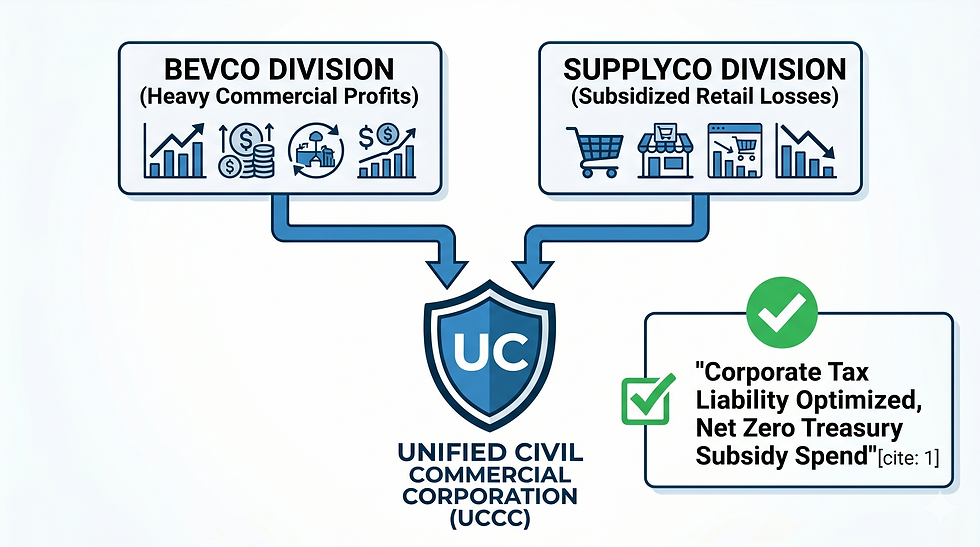
By legally merging the highly profitable Kerala State Beverages Corporation with the loss-heavy Kerala Civil Supplies Corporation (Supplyco) into a single consolidated corporate entity, the state pulls off an elite accounting maneuver.
Under a unified balance sheet, Supplyco’s losses on subsidised essential commodities are legally offset directly against Bevco’s heavy commercial liquor profits. This structural consolidation instantly lowers the entity's overall corporate tax outgo, completely erasing the need for the state government to write direct budgetary checks to keep Supplyco alive.
4. Powering the Seven Global Macro Vectors
Plugging these fiscal leaks is not just about balancing the books-it is about building the massive infrastructure foundation needed to capture the historic macro alignments of the global market:
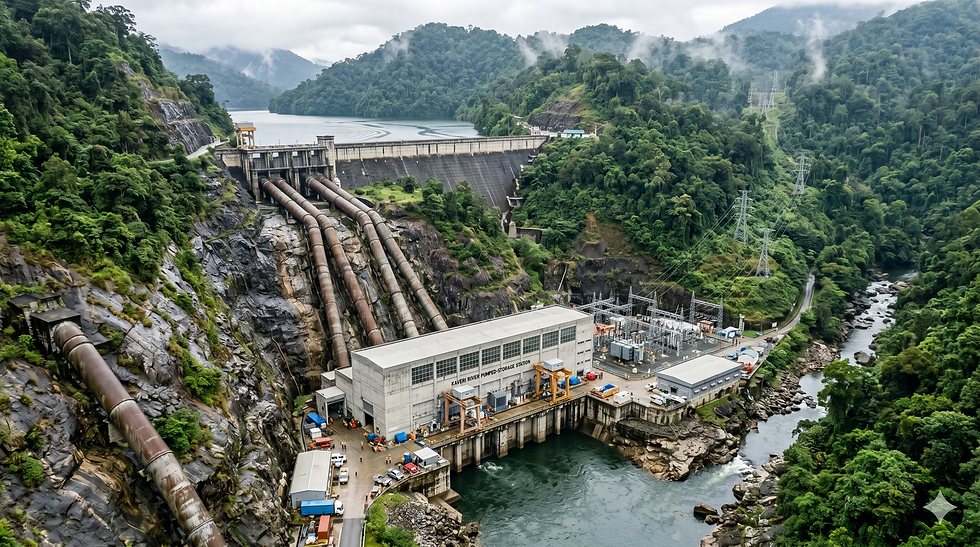
The Silicon Shift: Emerging sunrise industries—like boutique semiconductor chip design, spatial computing, and AI data centers—are hyper-intensive energy consumers. To fuel them, we are opening our power sector to private and Central public-sector investments, aggressively scaling low-cost clean energy through 6,000 MW of solar capacity and 8,000 MW of pumped hydro-electric storage.
Thorium Tech Dominance: By establishing highly secure engineering corridors around our coastal monazite sand deposits, Kerala can become the global epicentre for Thorium-based clean energy research, turning a raw mineral resource into a multi-billion-dollar technology monopoly.
Maritime Gateway Velocity: Connecting our deep-water transhipment assets at Vizhinjam and Vallarpadam to an LVC-funded, high-density industrial corridor turns our state into the undisputed maritime gateway of the Indian Ocean.
High-Value Eco-Tourism: Using our vertical space efficiency to freeze horizontal sprawl, we save 85% of our ground footprint for pristine forests and deep-asset Dutch polder flood shields. This permanently stabilises our coastal and backwater ecosystems, allowing us to capture ultra-high-net-worth travel and digital nomad capital year-round.
The Aerospace & Satellite Foundry: By leveraging our unparalleled geopolitical asset—the physical footprint of the Vikram Sarabhai Space Centre (VSSC) and ISRO setups in Thiruvananthapuram—the K-GBA scales beyond ground logistics into low-Earth orbit economies. We are establishing advanced component manufacturing parks, simulation centres, and micro-launch vehicle assembly foundries near our southern anchor. This allows our indigenous deep-tech ecosystem to natively co-develop next-generation aerospace payloads with international space agencies, short-circuiting the brain drain.
Quantum Computing & High-Performance Computing (HPC) Enclaves: To move completely past low-margin, legacy IT outsourcing, the K-GBA framework builds vertical tech parks specifically zoned for next-generation compute architectures. By anchoring centralised High-Performance Computing (HPC) arrays and quantum computing simulators within the Kochi Infopark and Trivandrum Technopark systems, the state provides local startups with the raw processing power required to run high-velocity, global artificial intelligence operations debt-free.
Marine Biotech & Nutraceutical Monopolies: Utilising our extensive coastal geography, the K-GBA framework converts traditional low-value fisheries into a hyper-intensive, high-value knowledge asset. The coastal stretches of Alappuzha and Kollam will host integrated marine biotechnology research laboratories and cold-chain distribution terminals. These facilities will process local aquaculture and marine flora into high-demand algae-based bio-products, value-added nutraceuticals, and advanced pharmaceuticals for international markets
5.The Structural Spatial Breakdown of the K-GBA Axes
To prevent resource fragmentation and localised bickering over investments, the K-GBA master plan maps out explicit spatial boundaries across three hyper-connected corridors :
Axis Name | Regional Geographic Core | Explicit Land Allocation Target | Cross-Border Supply Chain Sync |
Corridor 1 (The Industrial Spine) | Palakkad – Thrissur – Kochi | 20,000 Total Acres: 8k in Palakkad, 8k in Thrissur, 4k in Kochi | Direct expressway synchronisation with the industrial clusters of Coimbatore and Bengaluru. |
Corridor 2 (The R&D Anchor) | Thiruvananthapuram – Kollam | Vertical Density & Small Coastal Reclamation near regional ports | Direct logistics integration with Tamil Nadu's southern gateways (Madurai, Tiruchy, Kanyakumari) . |
Corridor 3 (The Northern Triangle) | Kasaragod – Kannur – Kozhikode | Brownfield Site Repurposing & fallow land pooling | Multi-modal cargo and tunnel connectivity through the Western Ghats to Mysuru and Mangaluru. |
6. Land Zoning and the 1,200 Sq. Km Tourism 2.0 Dividend
A critical point of failure in traditional urban planning is the chaotic mixing of industrial grime and ecological beauty. The K-GBA framework solves this through absolute, data-driven Zoned Development.
┌────────────────────────────────────────────────────────┐
│               THE K-GBA SPATIAL DIVISION               │
├────────────────────────────────────────────────────────┤
│ 15% Built Footprint ──► Hyper-Dense Vertical Clusters  │
│ 85% Eco-Redline     ──► Forests, Wetlands & Polders    │
│   └─► Includes 1,200 sq. km Earmarked Smart Tourism    │
└────────────────────────────────────────────────────────┘
By compacting all heavy manufacturing, semiconductor fabs, and deep-tech foundries vertically into dense transit nodes occupying just 15% of our land footprint, we unlock a massive spatial dividend over the remaining 85% of the state.
Within this preserved ground, we have earmarked 1,200 square kilometres of contiguous, non-industrial land exclusively for Sustainable Tourism 2.0. Emulating the high-value models of international tropical destinations, this layout locks away our fragile backwaters, the Western Ghats, and the Vembanad-Kol wetlands from real estate encroachment.
By expanding emission-free electric Water Metro fleets and developing luxury eco-cruise circuits along National Waterway 3, we create an integrated heritage and wellness circuit. Global tech investors and digital nomads can land at a hyper-dense logistics hub, step onto a low-carbon water transit line, and settle into a pristine, ecologically insulated resort within 45 minutes—experiencing a quality of life that concrete-heavy global cities simply cannot replicate.
Activating the Scenic Sport Infrastructure: The Pathas
The Malayora Patha (The Mountain Spine): Cutting through our highly regulated, ecologically insulated mountain landscapes, this scenic highway corridor is structurally engineered to host extreme adventure tourism, including international Moto GP-style rally circuits and eco-adventure trails. This design captures premium global travel capital without compromising the surrounding forest canopy.
The Theera Desha Patha (The Coastal Route): Running cleanly along the reclaimed coastal defences, this highway layout is zoned for zero commercial real estate sprawl. Instead, it functions as an elite infrastructure canvas for mega-sporting events, including international cycling marathons, sailing regattas, and coastal water sports championships. This effectively mimics the highly profitable, tourism-heavy formats of Thailand's Phuket or Phi Phi islands, directly integrated into Kerala's cultural ecosystem.
6. The K-GBA Is Ready for Takeoff
The White Paper has given us the ultimate wake-up call: the old playbook of debt-funded consumption is dead. But by merging progressive spatial design with off-balance-sheet financial engineering and bold utility reforms, we can transform our unique constraints into absolute global monopolies.

The engineering blueprints are validated. The institutional capital firewall is designed. It’s time to launch the SPVs, execute the playbook, and build the future of Kerala.
Our 3-part serialised masterclass is now complete. We have unboxed the past, diagnosed the present, and built a bulletproof, debt-free architecture for the future. Let’s move from theory to physical execution - share this manifesto across your networks and let us know your thoughts in the comments below.


Comments