The Re-Design - Why Kerala’s ₹5.07L Crore Debt Bomb is a Spatial Design Flaw

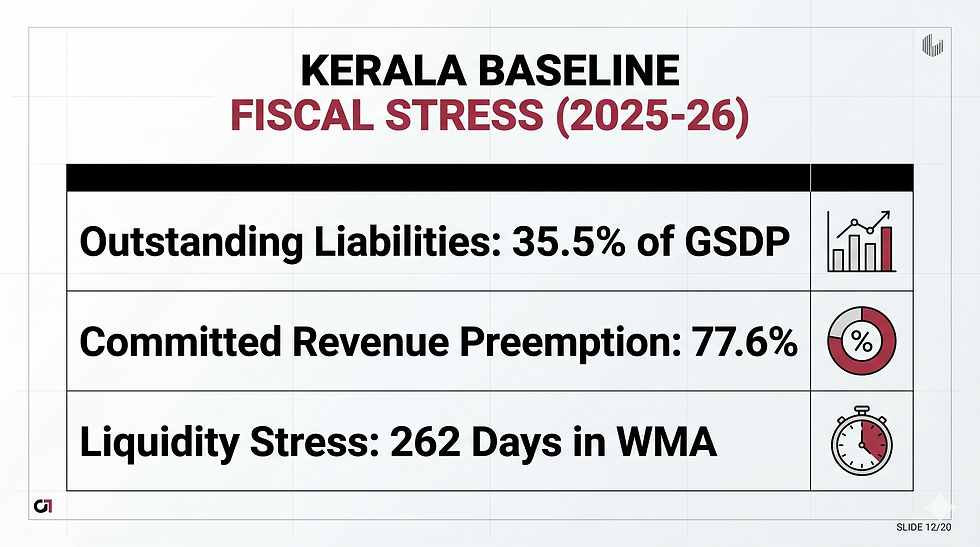
The tabling of the latest Financial White Paper, Kerala's Fiscal Health: A Status Report, has triggered a predictable wave of panic across the state’s political and economic circles. The numbers are undeniably brutal. We are told that Kerala is sitting on a ₹5.07 lakh crore debt bomb. We look at our screens and see a structural chokehold: an alarming 77.6% of our entire revenue is completely swallowed by committed expenditures—salaries, pensions, and interest payments on past debt.
The immediate casualty of this crisis? Our state’s future. Capital expenditure for actual development has flatlined at a minimal 1.34% of GSDP.
To survive daily cash drops, the treasury has been pushed into a state of permanent triage, spending 262 days a year in RBI Ways and Means Advances and 84 days in emergency Overdrafts. Local bill clearance limits at district treasuries have been quietly rationed by 99%, collapsing from ₹5 crore down to a restrictive ₹10–25 lakh threshold just to keep the lights on.
The conventional response from fiscal conservatives is immediate: Austerity. Cut spending. Tighten the belt.
But that is a 20th-century response to a problem they don't fully understand. Kerala's fundamental crisis is not a spending problem. It is a spatial design flaw.
1. The Concrete Flat Carpet: The Core Failure of Sprawl
When you examine the data through a macroeconomic lens, you realise that our structural deficit is driven by the physical way we develop our state. In a geography characterised by intense tropical monsoons and acute land scarcity, Kerala has spent decades enforcing an urban planning model that mandates horizontal sprawl.
By keeping our urban Floor Space Index (FSI) ceilings artificially low—historically restricted to a baseline of around $1.5x—our planning systems have legally forced the economy to spread flat across the ground like a concrete carpet.
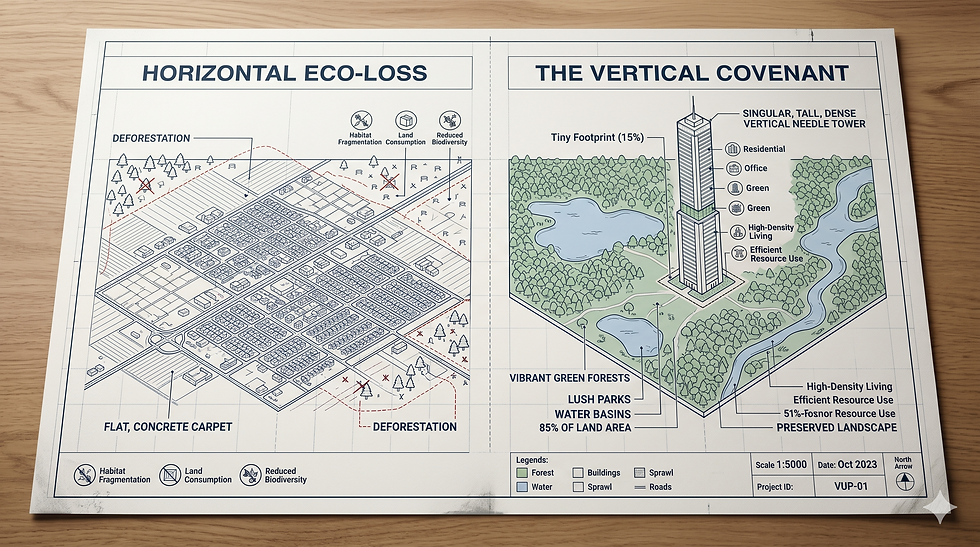
Forcing horizontal growth in a state with no land to spare is a mathematical absurdity. Horizontal sprawl does three things to destroy a state’s finances:
It drastically inflates the cost of infrastructure. Connecting fragmented, flat towns requires endless, multi-trillion-rupee road networks that the state must fund via predatory debt.
It triggers intense social friction. Assembling a single contiguous industrial zone or a modern high-speed transit corridor requires forcibly displacing thousands of families from their ancestral plots.
It creates ecological disasters. Flattening our landscape leaves zero ground footprint open to absorb rain, leading to localised flood cycles that cost the state billions in recurring disaster management.
2. Replicating the Greater Bay Area: Kerala as a Single Polycentric Megapolis
We need to stop trying to force hyper-growth into a single, congested, sprawling hub like Bengaluru or Chennai. Instead, we must look at a global blueprint that perfectly matches Kerala's geographic reality:
China’s Guangdong-Hong Kong-Macao Greater Bay Area (GBA).
The GBA model proved to the world that you do not need one single, massive city to build an economic superpower. Instead, they connected an entire 55,000 square kilometre region into a single, seamless, high-velocity "One-Hour Living Circle" using hyper-speed transit. The cities don't compete; they operate with a highly synchronised division of labour.
At roughly 39,000 square kilometres, Kerala is structurally identical to the GBA layout. We need to stop viewing our state as a collection of fragmented administrative districts and start framing it as a singular, interconnected polycentric eco-megapolis: the K-GBA.
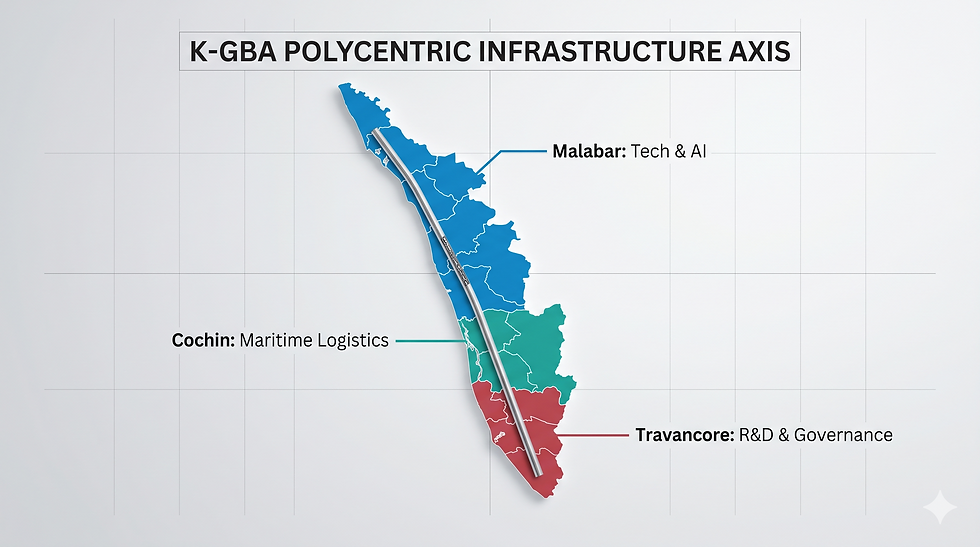
By connecting these three specialised nodes via a 350+ km/h transit spine, an engineer can live in a serene, green pocket of Alappuzha, hop on a high-speed train, and walk into an AI foundry in Kozhikode or a hardware design lab in Trivandrum within 45 minutes. Geography ceases to be a bottleneck and becomes our ultimate competitive advantage.
3. The Vertical Green Wall: Forest and Urban Hand-in-Hand
The moment we introduce this polycentric master plan, the immediate pushback from environmental sceptics is predictable: “If you build a state-wide megapolis, you will destroy Kerala's natural beauty, paddy fields, and backwaters.”
The answer is structural fusion. By passing a statutory framework that enforces radical FSI deregulation (8x to 12x vertical rights) exclusively inside our three compact urban nodes, we force the economy to grow upward, not outward.
This vertical configuration permanently freezes horizontal urban sprawl. Because human activity and real estate grow into dense vertical needles rather than flat concrete slabs, we achieve a historic dual dividend:
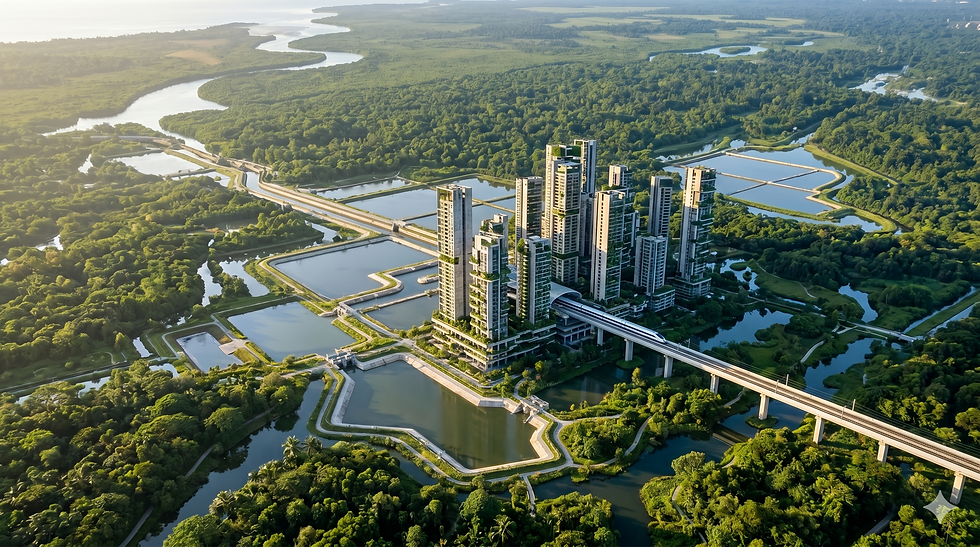
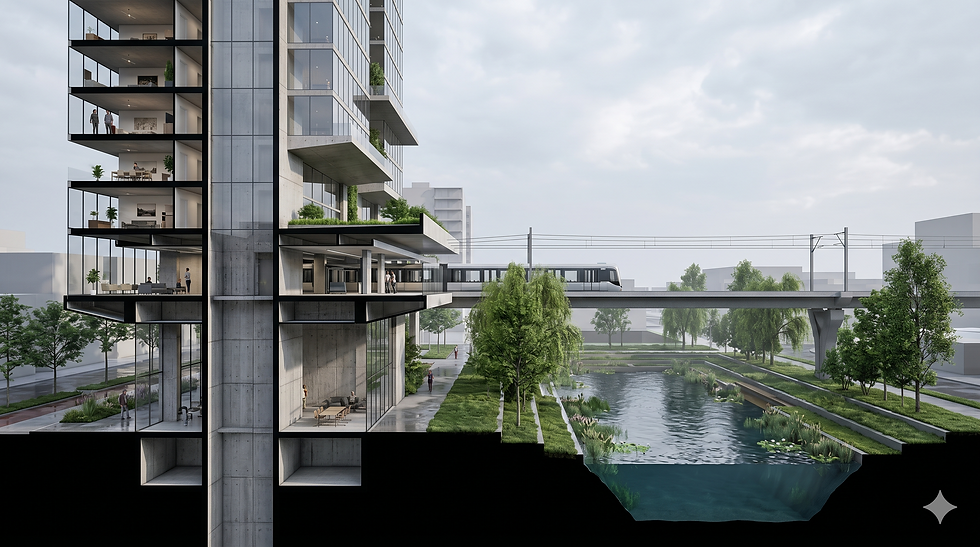
By compacting our economic hubs vertically, we leave up to 85% of the local ground footprint completely open. These open spaces are repopulated with native forest canopies and engineered into deep subsurface drainage arteries, Dutch-style polders, and advanced rainwater containment basins.
When the heavy monsoons arrive, these basins absorb the floodwaters effortlessly. The surrounding vertical towers remain dry, high-value, and fully operational, while the commercial lease value generated by the towers completely self-funds the water-management shields right next to them. High technology and our pristine tropical forests exist hand-in-hand.
4. The Path Beyond the Deficit Mindset
The White Paper has exposed the final limits of the old playbook. Running a state on a defensive, welfare-only deficit mindset financed by high-cost debt is no longer an option.
But Kerala does not lack wealth; it lacks the progressive spatial containers required to hold and capture capital.
We can build the high-speed transit spine, the autonomous offshore software zones, and the deep climate shields without spending a single rupee of taxpayer money or adding a single paisa to our ₹5.07 lakh crore debt stock. The mechanism is a complete pivot to off-balance-sheet financial engineering:
Land Value Capture (LVC).
The old playbook is officially bankrupt. The global capital is waiting on the sidelines, and the engineering blueprints are proven. It’s time to rewrite our spatial rules, unbox the future, and build the K-GBA.

In our next piece, Blog 2: The Money Engine, we will dive straight into the explicit financial engineering: how we can wind down the legacy KIIFB debt model, deploy high-FSI equity land pooling, and transform local landowners into dividend-earning corporate shareholders of our transit corridors. Stay tuned.
How do you view the shift from traditional horizontal development to a hyper-vertical eco-megapolis layout? Let’s map out the possibilities in the comments below.


Comments